Beyond the Clichés: Discovering the Secret Coves of the Côte d’Azur by Sailboat
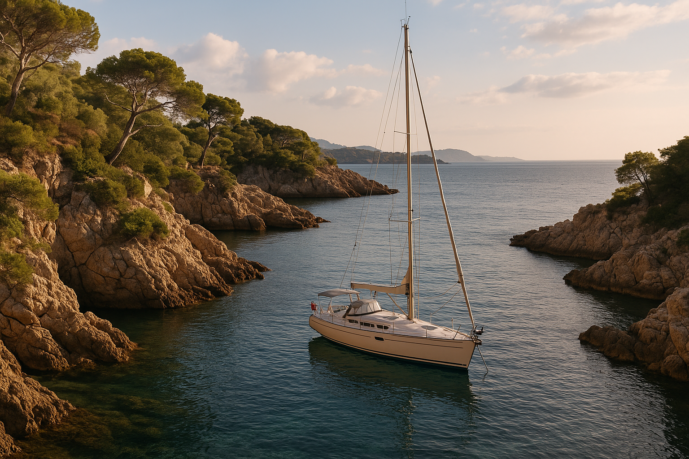
The French Riviera You Don’t Know
Trading Crowded Promenades for Secluded Anchorages
Mention the Côte d’Azur, and the mind conjures images of sun-drenched glamour: the vibrant chaos of the Promenade des Anglais in Nice, the celebrity-strewn Croisette in Cannes, the legendary traffic leading into St. Tropez. During the high season, this reality can be one of shoulder-to-shoulder crowds, bustling beach clubs, and the constant hum of a region at its peak. It is a spectacular, yet often overwhelming, experience.
But just beyond the shoreline, past the crowded marinas and out on the turquoise expanse of the Mediterranean, lies a different Riviera. This is a coast of quiet contemplation, of hidden coves lapped by crystalline water, and of limestone cliffs that plunge into the sea, accessible only to those who arrive by water. It is a world where the only sounds are the gentle lapping of waves against the hull, the cry of gulls, and the whisper of wind in the sails. This is the promise of the Côte d’Azur by sailboat: a private, intimate encounter with a coastline you thought you knew.
Why a Sailboat is Your Key to Unlocking the Coast
A car can get you to the coast, but a sailboat makes you a part of it. It fundamentally changes your relationship with the landscape, transforming you from a visitor on the land to a resident of the sea. The advantages are not just practical; they are experiential.
- The freedom to drop anchor where you please. This is the ultimate luxury. Your itinerary is not dictated by hotel availability or road access, but by the wind and your own curiosity. You can sail past a stunning, unnamed inlet, decide it’s the perfect spot for lunch, and simply stop. This spontaneity allows for genuine discovery, far from any prescribed tourist trail.
- A unique, quiet perspective. From the water, the familiar coastline reveals a new character. The dramatic red rocks of the Esterel Massif are more imposing, the distant Alps more majestic. You escape the noise of coastal roads and towns, trading the sound of engines for the rhythm of the sea. The day is governed by the sun’s arc, culminating in a private sunset viewed from your own deck.
- Access to the inaccessible. Many of the Côte d’Azur’s most pristine beaches and coves, known as calanques, are either protected from development, difficult to reach via strenuous hiking trails, or simply have no land access at all. A sailboat with a shallow draft can glide into these havens, places where larger yachts cannot venture, offering a level of seclusion that feels a world away from the nearby Riviera hotspots.
Planning Your “Insider” Sailing Trip
A successful voyage to the hidden corners of the French Riviera isn’t about luck; it’s about thoughtful preparation. The right vessel, the perfect timing, and a little local knowledge are the essential ingredients for transforming a standard holiday into an unforgettable exploration. This is where you trade the checklist for a chart and begin to think like a seasoned sailor.
Chartering the Right Vessel
Your sailboat isn’t just transportation; it’s your floating home, your access pass to secluded coves, and your front-row seat to the best views on the coast. Choosing wisely is the first step in crafting your ideal journey.
- Monohull vs. Catamaran: The classic choice is the monohull, which offers a rewarding sailing experience, heeling gracefully in the wind and cutting through waves with ease. They are generally more affordable to charter and can be found in abundance. A catamaran, on the other hand, provides exceptional stability at anchor (no rocking while you sip your morning coffee), a vast amount of deck and living space, and a shallow draft. This reduced depth can be a significant advantage for nosing closer to certain beaches and into shallower anchorages. For the Côte d’Azur, either is an excellent choice, with the decision often coming down to your group’s size and preference for living space versus pure sailing performance.
- Ideal Boat Size: To access the narrow, intimate calanques and smaller coves, nimbleness is key. A boat in the 38 to 45-foot range strikes the perfect balance between comfort for a small group or family and the maneuverability needed to navigate tighter spaces. Larger yachts are often too deep or wide to safely anchor in these prized spots, leaving them exclusively to smaller, more agile vessels.
- Skippered vs. Bareboat: If you hold a valid sailing qualification (like an International Certificate of Competence – ICC) and have experience in Mediterranean conditions, a bareboat charter offers the ultimate freedom. However, for those new to the area or simply wishing to relax completely, hiring a skipper is invaluable. A local skipper is more than a captain; they are a guide who knows the weather patterns, the best anchorages for the current wind direction, and which bakeries have the flakiest croissants. It’s the fastest way to gain true insider access.
When to Go for Maximum Seclusion
The high summer of July and August brings glorious heat but also peak crowds. To truly experience the tranquility of the coast, timing is everything. The shoulder seasons are when the Riviera reveals its more authentic, serene character.
The magic window is May, June, and September. During these months, you’ll discover a different world:
- Fewer Crowds: The anchorages are less congested, the small ports have more available berths, and the beaches are quiet. You’ll often find you have a small cove all to yourself for an afternoon.
- Pleasant Weather: The sun is warm and generous without the oppressive heat of mid-summer. The sea has had time to warm up, especially by September, making for perfect swimming conditions.
- Better Availability: From charter boats to mooring buoys, you’ll have more choice and often more competitive pricing than in the peak season.
Essential Navigation and Mooring Know-How
Sailing here is straightforward, but a few key pieces of knowledge will set you apart, ensuring a safe, smooth, and responsible trip. This is the practical wisdom that turns a tourist into a true mariner.
- Charts and Navigation: While digital navigation apps like Navionics are incredibly convenient and widely used for planning and real-time positioning, they should not be your only source. Prudent seamanship dictates having official paper charts onboard, specifically the French SHOM (Service Hydrographique et Océanographique de la Marine) charts for the region. They are the definitive source and an essential backup in case of electronic failure.
- Respecting the Posidonia: This is perhaps the most critical piece of local knowledge. The seabed of the Mediterranean is home to vast meadows of Posidonia oceanica, a protected seagrass that is vital to the marine ecosystem—it produces oxygen, prevents coastal erosion, and acts as a nursery for fish. Anchoring in these dark green patches is forbidden and can result in heavy fines. It also destroys a fragile, slow-growing habitat. Always aim to drop your anchor in patches of light-coloured sand, which you can often spot from the deck in the clear water. Your charts will also mark protected areas. Protecting the Posidonia is the mark of a responsible and respectful sailor.
- Mastering the “Med-Moor”: In many of the charming small ports, you won’t be mooring alongside a pontoon. Instead, you’ll perform a “Med-moor” (mooring stern-to). This involves dropping your anchor from the bow about four to five boat lengths out from the quay, then carefully reversing into your spot, securing the stern to the dock with two lines. Prepare your lines and fenders in advance, communicate clearly with your crew, and don’t hesitate to accept a helping hand from the capitainerie (harbour master) or a neighbouring boat. It’s a common, communal manoeuvre that you’ll quickly get the hang of.
The Secret Coves: An East-to-West Itinerary
This is not a checklist, but a chart of possibilities. Our journey moves from the protected national parks east of Toulon towards the dramatic limestone fjords near Marseille. Each stop offers a distinct character, a unique palette of colors, and a different kind of quiet. Use this as your guide, but let the wind and your curiosity lead you to discover your own private anchorage along the way.
The Golden Isles (Îles d’Hyères): A Protected Paradise
Just off the coast from Hyères lie three islands—Porquerolles, Port-Cros, and Île du Levant—that feel like a world apart from the mainland Riviera. Known as the Îles d’Hyères, or “Golden Isles,” they are a sanctuary of protected nature, offering some of the most pristine anchorages in the Mediterranean.
Plage Notre Dame, Porquerolles
Often lauded as one of Europe’s most beautiful beaches, Plage Notre Dame can feel surprisingly private when you arrive under sail. The key is approaching from the sea, bypassing the crowds who arrive by ferry and foot. As you enter the wide, arcing bay, consult your charts to find a clear patch of sand for your anchor, well away from the protected posidonia seagrass. The water here is a startling shade of turquoise, and the beach is backed by fragrant pines and eucalyptus. Once anchored, the shore is just a short dinghy ride away.
Onshore tip: Porquerolles is best explored on two wheels. Rent a bicycle from the main village and pedal through dusty tracks lined with vineyards and olive groves. A visit to one of the local domaines for a tasting of the island’s crisp rosé is an essential part of the experience.
Port-Cros: The Wild National Park
To drop anchor at Port-Cros is to agree to its terms. As France’s first maritime national park, it is a fiercely protected wilderness, and the rules are strict for a reason. Anchoring is forbidden in most areas to protect the fragile seabed. Instead, you must use the designated, paid mooring buoys in the Baie de Port-Man or the main harbor. Adhering to these regulations is not a suggestion; it is a fundamental part of being a responsible mariner here. Your reward for this diligence is unparalleled. The island is a haven for wildlife, with no cars and limited development. The water clarity is exceptional, making it a snorkeler’s dream. Don’t miss Le sentier sous-marin de la Palud, an underwater trail with submerged plaques that identify the local marine life. It is a profound experience of unspoiled nature.
The Esterel Massif: Red Rocks and Turquoise Water
Between Cannes and Saint-Raphaël, the coastline undergoes a dramatic transformation. The gentle, pine-clad shores give way to the rugged Esterel Massif, where ancient volcanic rock of a deep, rusty red plunges into the turquoise sea. This stretch is riddled with tiny coves, or calanques, accessible only by boat, offering some of the most visually stunning anchorages on the coast.
Calanque des Anglais
Tucked beneath the Corniche d’Or road, the Calanque des Anglais is a perfect example of the Esterel’s magic. The name translates to “Cove of the English,” but you’ll feel a world away from any crowds. The visual contrast is breathtaking: the ochre and crimson of the porphyry rock set against the deep blues and greens of the water. Carefully navigate your way into this narrow, sheltered inlet, drop anchor, and shut off the engine. The silence, broken only by the lapping of water against the hull, is immediate. This isn’t an overnight spot, but it is the ideal location for a private lunchtime swim, feeling completely hidden from the bustling Riviera just miles away.
Plage de l’Escalet (near Ramatuelle)
Just around the corner from the legendary beach clubs of Pampelonne is a coastline the locals have long kept to themselves. Plage de l’Escalet is not one single beach but a series of small, sandy coves interspersed with smooth, sun-bleached granite boulders. While the main beach is accessible by land, the real secrets are found by water. Navigate carefully around the rocky islets (the “Torpilles”) to find your own patch of sand to anchor over. From here, the best exploration is done by dinghy or paddleboard. You can weave through the rocks to discover tiny, unnamed beaches where your party might be the only visitors for the entire afternoon.
The Calanques National Park: The Fjords of the Med
West of Cassis, the coast rises into a magnificent spectacle: the Parc National des Calanques. Here, for over 20 kilometers, towering white limestone cliffs have been carved by time into deep, fjord-like inlets. Sailing into a calanque is an awe-inspiring experience, a journey into the geological heart of Provence.
Calanque d’En-Vau
The approach to Calanque d’En-Vau is one of the great moments of Mediterranean sailing. You guide your vessel between immense, sheer white cliffs that seem to close in around you, the scale of the landscape making your boat feel like a child’s toy. Anchoring here presents a challenge; the inlet is deep and narrow, requiring plenty of chain and careful positioning. But the reward is immense. Once the anchor is set, you are completely enveloped by nature. The echo of seabirds bounces off the cliffs, the scent of Aleppo pine drifts down from the slopes, and the water, a cool, emerald green, invites you in. It’s a place of profound peace, where the modern world feels not just distant, but nonexistent.
Calanque de Sormiou
While still wild, Calanque de Sormiou feels more lived-in than its neighbor, En-Vau. This larger inlet is home to a small community of cabanons, traditional fishing cottages (now mostly summer homes) that line the small beach, adding a touch of human history to the grandeur of the landscape. Because of the local moorings, finding a spot to anchor requires a bit more finesse; aim for the edges of the bay, giving the small fishing boats plenty of room. The unique charm of Sormiou lies in this blend of nature and tradition.
Insider tip: For a truly memorable meal, make a reservation well in advance at Le Château Sormiou, a restaurant right on the beach. You can anchor in the bay and arrange to come ashore by dinghy, enjoying a spectacular lunch with your sailboat bobbing in view—the perfect synthesis of the sailor’s life and Provençal hospitality.
Living the Sailor’s Life
Beyond the navigation and anchorages, embracing the rhythm of life at sea is what transforms a sailing trip into a truly memorable experience. It’s about slowing down, savoring the simple pleasures, and connecting with the Provençal culture from the unique vantage point of your own floating home.
Provisioning Like a Local
One of the great joys of this journey begins before you even cast off the lines. Skip the hypermarkets and instead immerse yourself in the vibrant morning markets of the coastal towns. The daily market in places like Le Lavandou or the charming port of Cassis is a feast for the senses and the perfect way to provision your galley. The air is thick with the scent of herbs, lavender, and ripe melons. Here, you’re not just a tourist; you are participating in a timeless local ritual.
Focus on simple, fresh ingredients that require minimal cooking and perfectly complement a sun-drenched afternoon. Your market list should include:
- Rosé de Provence: An absolute essential. Ask a vendor for their local recommendation; it will be dry, pale, and perfect when chilled.
- Local Cheeses: Look for a fresh, creamy chèvre (goat cheese) often decorated with a sprig of rosemary, or a slice of firm Tomme de Provence.
- Tapenade and Anchoïade: Rich, savory spreads made from local olives and anchovies that are perfect on fresh bread.
- Fresh Produce: Sun-ripened tomatoes, fragrant basil, sweet peppers, and of course, a few heads of garlic.
- A Baguette: No French meal is complete without it. Buy it just before you head back to the boat for maximum freshness.
The Onboard Sundowner (Apéro)
The French ritual of the *apéro* takes on an almost sacred quality when enjoyed from the cockpit of your sailboat. As the sun begins to dip, casting a golden glow across the water and illuminating the cliffs, it’s time to pause. The engine is off, the anchor is set, and the only sounds are the gentle lapping of waves against the hull and the distant cry of gulls.
This is the sailor’s reward. It requires no complex preparation. Chill the rosé in a bucket of seawater. Slice the saucisson, lay out the cheeses and olives, and spread tapenade on pieces of baguette. For a classic Provençal touch, pour a small measure of Pastis into a glass and watch it turn a cloudy white as you slowly add chilled water. This daily ceremony is a moment to reflect on the day’s sail, plan the next morning’s journey, or simply sit in comfortable silence, watching the first stars appear in the sky.
Respectful Seamanship: Leave No Trace
The privilege of accessing these pristine coves comes with a profound responsibility to protect them. The “insider” sailor is not just one who knows where to go, but one who knows how to behave. Preserving the beauty and tranquility of the Côte d’Azur for others—and for the future—is paramount. This ethos of respectful seamanship is non-negotiable.
- Waste and Water: Absolutely nothing is thrown overboard. Use your boat’s holding tanks for all black water and dispose of it at designated pump-out stations in port. All rubbish must be stowed securely onboard and discarded properly ashore. The rule is simple: leave the anchorage cleaner than you found it.
- Sound and Silence: Remember that sound travels effortlessly across water in a quiet anchorage. Keep music and conversations at a respectful volume, especially in the evening and early morning. The peace of a secluded cove is a shared treasure.
- Marine Life: If you are lucky enough to encounter dolphins or other marine wildlife, consider it a gift. Slow down, cut your engine if it is safe to do so, and observe from a distance. Never pursue or crowd them. You are a visitor in their home.
Your Chart to a Different Riviera
The Freedom of the Unwritten Itinerary
Consider the itinerary we’ve shared not as a rigid map, but as a compass pointing you toward a more authentic experience. The true beauty of exploring the Côte d’Azur by sailboat lies in embracing the unwritten schedule. Your days are dictated not by reservations and traffic, but by the direction of the wind, the clarity of the water, and a promising patch of blue on the horizon. A whisper of the mistral might guide you to a sheltered anchorage you hadn’t planned for, or a chance conversation with another sailor could lead you to a cove not found in any guide.
Use these suggestions as your starting point. Peek around the next headland, drop your anchor in that unnamed inlet, and allow curiosity to be your guide. The greatest reward of this journey is discovering your own Calanque Secrète—a place that, for a quiet afternoon or a peaceful night, belongs only to you.
Swapping Glitz for Authenticity
This is a journey of deliberate exchange. You trade the thumping bass of a St. Tropez nightclub for the profound silence of a starlit anchorage, broken only by the gentle lapping of waves against the hull. You swap the crowded promenades and designer boutiques for untouched nature and the simple elegance of a sun-drenched deck. The true currency of this coast isn’t found in its casinos, but in the richness of its sunsets and the clarity of its waters.
Picture it: The day’s heat softens into a golden glow. Your hand rests on the tiller, feeling the gentle tug of the rudder as the sails draw the last of the afternoon breeze. Ahead, the red rocks of the Esterel are silhouetted against a deepening orange sky. You are aiming for a sliver of calm water, a secluded anchorage for the night. There are no crowds here, no reservations, no expectations. There is only the rhythmic sound of the sea, the scent of salt and pine on the air, and the quiet satisfaction of having found the true, beating heart of the Côte d’Azur.