Des plages de sable noir aux forêts verdoyantes : Un voyage à la voile à travers La Palma et El Hierro
The Call of the Western Isles: A Voyage to the Edge of the Map
Setting Sail for the ‘Islas Verdes’
There’s a different pull to the westernmost Canary Islands. While their eastern neighbours are famed for golden sands and bustling resorts, La Palma and El Hierro whisper a different promise—one of raw, untamed nature. Known as the ‘Islas Verdes’, or Green Islands, they are defined not by what has been built upon them, but by the powerful volcanic forces that created them and the lush, resilient life that clings to their slopes. The decision to sail west is a decision to seek out this wilder spirit, to trade the familiar for the elemental.
Our journey began in the quiet harbour of Valle Gran Rey on La Gomera. The morning was spent in the familiar rituals of preparation: checking charts, stowing provisions, and casting a final eye over the rigging. The plotted course was a simple line across a vast expanse of blue, but it felt like tracing a path to a forgotten world. There was a quiet hum of anticipation on the pontoon, a shared understanding among the few crews heading west that we were leaving the more trodden paths behind. The air itself seemed to hold a different quality—thinner, cleaner, and filled with the scent of open ocean.
Casting off the lines felt like a definitive severing. As the familiar cliffs of La Gomera slowly softened into a hazy silhouette behind us, the world simplified. It became the creak of the hull, the steady pressure of the wind in the sails, and the rhythmic slap of waves against fibreglass. This wasn’t just a journey from one island to another; it was a passage away from the noise of modern life, a deliberate immersion into the simple, powerful realities of wind, water, and time.
First Sight: La Palma Rising from the Atlantic
After hours at sea, with nothing but the deep, sapphire blue of the Atlantic in every direction, it appeared. At first, it was just a smudge on the horizon, a darker tone of grey that could have been a cloud. But slowly, with a profound and steady presence, La Palma began to rise from the water. It didn’t just appear; it asserted itself, a colossal shield volcano whose sheer scale is impossible to grasp from a map. The island’s silhouette was formidable, a jagged spine of peaks culminating in the great caldera, a testament to its violent geological birth.
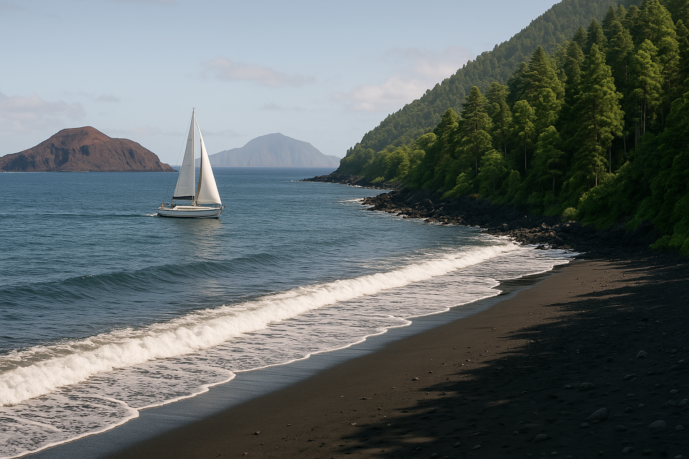
As we drew closer, the details sharpened into a breathtaking contrast of colour. The immense volcanic slopes, which from a distance looked like a single dark mass, resolved into a tapestry of deep, vibrant greens. Forests and vegetation clung tenaciously to every ravine and ledge, a lush cloak thrown over the dark volcanic rock. This verdant life tumbled all the way down to the coast, where it met the brilliant, churning blue of the ocean. It was a primal and dramatic meeting of elements.
The sense of scale was humbling. Our sailboat, which had felt like a capable vessel in the open ocean, was now dwarfed by the island’s immensity. Looking up at those towering cliffs and forested peaks, you feel a profound sense of discovery. The island wasn’t just a destination; it was a world unto itself, promising hidden valleys, ancient forests cloaked in mist, and coastlines forged by fire. The journey across the water was over, but the real adventure, the exploration of this beautiful island, was just about to begin.
La Palma: The Beautiful Island of Fire and Forest
Dropping Anchor at Tazacorte: A Harbour Carved from Lava
Our approach to La Palma’s western coast culminates at Tazacorte, a port that feels less constructed and more hewn from the island itself. As we guide the boat into the marina, the first sensation is the change in the air. The cool sea breeze gives way to a contained warmth that radiates from the dark stone of the harbour walls. The dominant sound is the deep, rhythmic percussion of the Atlantic swell meeting the immense breakwater, a constant reminder of the ocean’s power. Looking up from the water level is an exercise in perspective; colossal cliffs, streaked with the impossibly vibrant green of banana plantations, seem to tumble directly into the sea, a sheer wall of life and geology that defines this sun-drenched corner of the island.
The Black Sand Coastline: Where Volcanoes Meet the Waves
A short journey from the port leads to the coastline proper, a place where the island’s volcanic heart is laid bare. Stepping onto the shore at Charco Verde is a lesson in sensory contrasts. The black sand, fine as dust, retains the sun’s heat with an intensity that you feel through the soles of your shoes. It’s a landscape of stark beauty, where the visual drama is matched by the sounds. The waves don’t just crash; they arrive with a hiss as the water spreads thin across the hot sand. As each wave retreats, it creates a deep, guttural grinding, the sound of countless volcanic pebbles being dragged against one another in the surf. It’s a raw, elemental music. The stark, graphic image of brilliant white foam spreading across the jet-black shore is a sight that stays with you, a perfect monochrome portrait of creation.
Ascending into the Clouds: The Ancient Laurel Forests of Los Tilos
To truly understand La Palma, one must leave the coast and ascend. The drive inland is a journey through climates. The sun-baked, arid coast slowly gives way to increasing humidity and dropping temperatures. Entering the laurel forest of Los Tilos is like stepping into a prehistoric world. The air becomes cool and heavy with the scent of damp earth and decaying leaves. Giant ferns and moss-covered laurel trees form a dense canopy, and the world is filtered into a thousand shades of green. Water is everywhere, dripping from leaves, running in small rivulets, and hanging in the air as a fine, persistent mist. The contrast with the bright, hot coastline left behind just an hour ago is profound. Here, in the island’s green, dripping heart, you feel a sense of ancient stillness and immense, quiet life.
At the Roof of the Island: The Caldera de Taburiente
The final ascent takes you to the very top of La Palma, to the Roque de los Muchachos. After a journey of winding mountain roads, you arrive at the edge of one of nature’s most magnificent creations: the Caldera de Taburiente. It is not a volcanic crater, but a massive erosion caldera, a vast bowl eight kilometres across where the island has simply collapsed and washed away over millennia. The scale is breathtaking. From the viewpoint, the world falls away into a chasm of jagged peaks and forested slopes, often with a sea of clouds filling the crater below, leaving you standing on an island in the sky. It is this incredible altitude and clear, stable air that makes La Palma a premier location for astronomy. The silver domes of international observatories dot the summit, silent testaments to the landscape’s gift. The same geology that provides this awe-inspiring view also lifts you above the atmospheric turbulence, offering a window into the cosmos of unparalleled clarity. It’s a powerful connection; the dramatic earth beneath your feet is your gateway to the stars.
The Ocean Passage: A Blue Bridge to El Hierro
Leaving La Palma’s Shores
There is a unique blend of melancholy and excitement in watching a beautiful island recede in your wake. Casting off the lines from Tazacorte, we pointed our bow south, and the grand slopes of La Palma began to flatten and soften with distance. The “Isla Bonita,” with its deep green ravines and cloud-wreathed summit, slowly condensed into a silhouette against the morning sun. Soon, it was just a memory on the horizon, a world we had just inhabited now suspended in the past. In its place, an expanse of open ocean. This is the transition point, a moment of pure suspension between two distinct worlds, where the only certainty is the sea beneath and the destination yet to be seen.
Life on the Open Water
The passage between the islands is a world unto itself, governed by the rhythm of wind and water. The boat settles into a steady cadence: the gentle creak of the rigging, the consistent rush of the hull slicing through the waves, and the firm pressure of the trade winds in the sails. Time loses its sharp edges, measured instead by the shifting angle of the sun and the changing texture of the sea. It’s a meditative state, broken by moments of sheer wonder.
The deep Atlantic channel here is a highway for cetaceans. A quiet watch was rewarded first by the sleek, dark fins of a pod of pilot whales, their slow, deliberate movements exuding a calm intelligence. Later, a flash of energy as a group of Atlantic spotted dolphins joined us, racing the bow and leaping from the water with an infectious joy. Overhead, Cory’s shearwaters glided effortlessly, their wingtips seeming to kiss the surface of the waves. The water itself transformed from the turquoise of the coast to an astonishingly deep, almost violet-blue, a colour so intense it feels ancient and profound.
El Hierro on the Horizon: A Fortress of an Island
After hours of seeing nothing but sea and sky, it appears. El Hierro does not rise gently; it erupts. Where La Palma was a vast, sprawling pyramid, El Hierro presents itself as a fortress. Its coastline is a wall of sheer, rugged cliffs that seem to defy any attempt at landing. It looks more compact, more primal, and somehow wilder than its neighbour. There are no gentle slopes tumbling into the sea, only a stark, dramatic line drawn against the sky. It is an island that feels geologically younger, rawer, and more secretive. This is the first impression of the island once known as the “End of the World,” and it is a fittingly formidable one.
El Hierro: The Island at the End of the World
If La Palma is the ‘Isla Bonita’, El Hierro is the ‘Isla con Alma’—the island with a soul. Once the westernmost point of the known world, it retains a feeling of being at the edge of everything. Its cliffs don’t just meet the sea; they command it. Its landscapes are not merely beautiful; they are profound, shaped by wind, water, and a deep, quiet volcanic heartbeat.
La Restinga: Gateway to a Volcanic Underworld
Our first port of call, La Restinga, feels like the last outpost of Europe. The small fishing harbour, nestled on the island’s southern tip, is unassuming and peaceful. Boats bob gently in the clear water, and the pace of life slows to the rhythm of the tides. This tranquility belies the dramatic forces at play just offshore. The harbour sits on the edge of the Mar de las Calmas, a marine reserve renowned for its calm waters and exceptional biodiversity, making it a world-class diving destination.
Yet, this calm was famously shattered in 2011 when the submarine volcano, Tagoro, erupted just a few kilometres from the coast. The event was a powerful reminder that El Hierro is a living, breathing geological entity. Today, the sea has healed, and the marine ecosystem has shown remarkable resilience. Arriving here is to understand that the island’s most dramatic landscapes are not just the ones you see, but also the ones hidden beneath the waves, a world forged and reforged by fire.
El Sabinar: Where the Wind Sculpts the Landscape
To understand the character of El Hierro, one must travel to the windswept western plateau of La Dehesa to witness El Sabinar. Here, ancient juniper trees have been bowed into submission by the constant force of the trade winds. They are not merely trees but living sculptures, their trunks and branches twisted into gnarled, horizontal forms that crawl across the rocky ground. Each one tells a story of survival, a testament to enduring strength against relentless pressure.
Walking among these natural monuments is a humbling experience. The air is thin and clean, the silence broken only by the whisper of the wind that shaped everything around you. The landscape is harsh, sparse, and profoundly beautiful, a visible expression of the island’s tenacious spirit.
A Journey of Microclimates: From Arid South to Lush El Golfo
Driving across El Hierro is a journey through a continent in miniature. The island’s spine acts as a great climate divide. You leave the arid, sun-baked volcanic plains of the south and ascend through fragrant pine forests into the cool, misty highlands. Then, as you begin the descent north, the world changes completely. Before you lies the spectacular valley of El Golfo, a vast, green amphitheater formed by a colossal prehistoric landslide.
This verdant crescent, filled with vineyards and fruit plantations, sweeps down to a rugged coastline pounded by the Atlantic. Tucked into this lava-forged shore are natural treasures like La Maceta and Charco Azul. These are not swimming pools but natural basins of turquoise water, protected from the ocean’s swell by volcanic rock. To swim here is to immerse yourself in the landscape, feeling the raw power of the island in the cool, clear saltwater.
The Sacred Heart: The Garoé Tree and Fertile Highlands
At the very heart of El Hierro, in its damp and fertile highlands, you find the island’s soul. This is the land of the Bimbache, the island’s original inhabitants, and their sacred Garoé tree. The original tree, a large laurel, was a miracle of nature, its leaves capturing moisture from the passing clouds—a phenomenon known as horizontal rain—and dripping fresh water to sustain the people.
Though the original was felled by a storm centuries ago, a new one stands in its place, a symbol of the island’s deep connection to its environment. To stand in this misty, green sanctuary is to feel the weight of history and the quiet magic of the land. It’s a place of profound peace, where the clouds stoop to kiss the earth, and you understand that the story of El Hierro is, and has always been, a story of water, resilience, and reverence for the natural world.
Reflections from the Helm: A Tapestry of Green and Black
Two Islands, One Primal Spirit
As the sails catch the wind for the journey home, the images of the past days merge into a vivid tapestry of colour and form. To sail to La Palma and El Hierro is to visit two siblings with the same volcanic heart but entirely different souls. They are both defined by the interplay of fire and water, of black rock and verdant life, yet they express this duality in unique ways.
La Palma is the ‘Isla Bonita’, the beautiful island, and its beauty lies in its magnificent scale. It is an island of grand gestures: the colossal chasm of the Caldera de Taburiente, the towering laurel forests of Los Tilos that seem to touch the clouds, and the sweeping black sand coastlines that stretch for miles. Its drama is cinematic, a landscape that unfolds before you with breathtaking breadth and height.
El Hierro, in contrast, offers a more concentrated, soulful wildness. It feels ancient and intimate. Its landscapes don’t just impress you with their size; they speak to you of endurance and spirit. The twisted juniper trees of El Sabinar are a physical manifestation of resilience, while the fertile mists of the highlands whisper tales of the sacred Garoé tree. It is less a spectacle and more a meditation—a compact world of intense character that invites quiet contemplation.
Practical Tips for Your Own Sailing Adventure
Embarking on a similar voyage requires some planning, but the rewards are immeasurable. The western Canaries offer some of the most memorable sailing in the archipelago, a true departure from the more beaten paths. Here are a few considerations for your journey.
- Best Time of Year: The shoulder seasons, from April to June and September to November, are often ideal. You’ll find pleasant temperatures, fewer crowds, and generally reliable trade winds for sailing. The Atlantic can be unpredictable, so always keep a close watch on marine forecasts, particularly for wind acceleration zones between the islands.
- Key Marinas and Anchorages: On La Palma, the marina at Tazacorte is an excellent, well-protected base on the sunny west coast, placing you right beside the dramatic cliffs and banana plantations. On El Hierro, the small southern port of La Restinga is the primary destination for visiting sailors. It’s a welcoming fishing village and the perfect gateway to the Mar de las Calmas marine reserve.
- Inland Exploration: A sailing vessel gets you to the islands, but the heart of their unique landscapes lies inland and uphill. To fully appreciate the contrasts between coast and interior—to stand at the rim of the Caldera or wander through El Golfo valley—renting a car for a day or two is essential. The islands’ steep topography makes land transport a necessary part of the adventure. Local bus services, or ‘guaguas’, offer an alternative for those with more time and a desire for local immersion.