Sailing: an old way to travel
Explore the timeless allure of sailing, a traditional mode of travel that connects us to the sea and history.
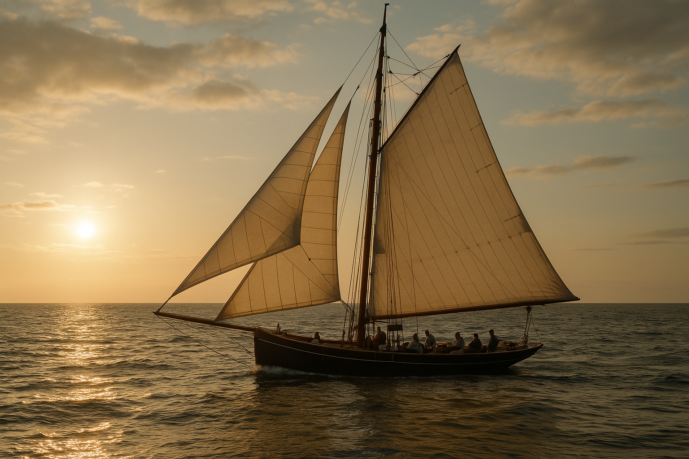
The Enduring Allure of Wind and Water
Beyond a Sport: Rediscovering a Primal Form of Travel
In our modern world, travel has become an exercise in efficiency, a means to an end. We are sealed in pressurized cabins, watching the world blur past a train window, or navigating traffic with our focus fixed solely on the destination. We arrive, but we miss the space in between. Sailing offers a profound counter-narrative. It is not about conquering distance but about inhabiting it. The journey itself, with its unscripted pace and intimate rhythms, becomes the primary experience.
To sail is to enter into a unique partnership with nature. It is a dialogue conducted with the subtle language of a telltale’s flutter, the tension on a sheet, and the gentle heel of the boat. You do not force your will upon the ocean; you learn to listen, to anticipate, and to harness the immense, invisible forces of wind and current. This act of collaboration, of moving in concert with the elements, re-establishes a connection to the physical world that is often lost in the detachment of contemporary life.
A Direct Connection to History
Casting off the lines of a sailboat is like opening a book written in sea salt and wind. In the whisper of the breeze across the canvas, one can hear the echoes of millennia. You feel a kinship with the ancient Polynesians who navigated vast oceanic expanses by the stars and the swell, with the Vikings whose longships carved paths of trade and conquest, and with the Age of Discovery explorers who first charted the globe under sail. You are not merely using an old method; you are participating in a living tradition, employing the same fundamental principles that have propelled humanity across the water for thousands of years.
This connection transforms one’s understanding of global geography. A map is no longer a static, two-dimensional image. From the deck of a sailboat, the world reveals itself as a dynamic system of prevailing winds, powerful currents, and formidable coastlines. You begin to understand why civilizations rose on certain shores, why trade routes followed specific paths, and why rounding a cape was a monumental achievement. You learn the planet not as a collection of places, but as a cohesive, breathing entity governed by the sea.
A History Written on the Waves
The Dawn of Sail: From Trade to Exploration
To set sail is to take part in one of humanity’s oldest and most consequential endeavors. Long before it was a pastime, it was the engine of progress. The ancient Egyptians harnessed the wind to ply the Nile on reed boats, while the Phoenicians, master mariners of their time, built robust trading networks across the entire Mediterranean. Perhaps most astonishing were the Polynesians, who navigated vast, empty stretches of the Pacific in double-hulled canoes, using a sophisticated understanding of stars and swells to discover and settle remote islands. For these cultures, a sail was not a luxury; it was the key to sustenance, expansion, and connection.
This early ingenuity culminated in the “Age of Sail,” a period stretching roughly from the 16th to the mid-19th century. During this era, towering masts and acres of canvas transformed the world. Tall ships became the primary instruments of global exploration, commerce, and power. They connected continents, enabling the exchange of goods, ideas, and cultures on an unprecedented scale, while also building and sustaining empires. The world economy, for the first time, became truly global, all of it driven by the wind.
Different challenges demanded different designs. The Portuguese Caravel, with its lateen sails, was nimble and could sail effectively against the wind, making it the vessel of choice for explorers charting unknown coastlines. The versatile Schooner, with its fore-and-aft rigging, was a workhorse for coastal trade and fishing, prized for its speed and ability to be handled by a small crew. The ultimate expression of sail power was the Clipper ship, a masterpiece of design built for one purpose: speed. These sleek vessels raced across oceans to deliver high-value cargo like tea and wool, representing the zenith of commercial sailing before the inevitable rise of steam power.
The Art of Pre-Digital Navigation
Before the quiet certainty of a GPS screen, finding one’s way across the open ocean was an art form—a complex discipline requiring intellect, intuition, and an intimate relationship with the cosmos. Navigation was not a passive act of receiving information, but an active process of deduction and interpretation. The navigator’s mind was the central processor, constantly weaving together disparate threads of information to plot a course through the vast blue unknown.
The sky was the primary map. Using instruments like the astrolabe and later the more precise sextant, a mariner could measure the angle of the sun at noon or the height of the North Star above the horizon to determine latitude—their position north or south of the equator. Finding longitude was a far more complex puzzle, one that involved intricate calculations and the use of precise chronometers. This celestial navigation was a daily ritual, a conversation with the heavens that grounded the ship in the geography of the planet.
Between these celestial fixes, sailors relied on dead reckoning. This was the methodical practice of estimating a ship’s position by tracking its course, its speed through the water, and the time that had passed. It was an exercise in meticulous record-keeping and educated guesswork, where a small error in judging current or leeway could compound over days into miles of uncertainty. It demanded constant vigilance and a deep familiarity with the vessel’s behavior.
Beyond instruments and charts, the most seasoned navigators possessed a profound, almost instinctive, knowledge of the environment. They learned to read the story told by the elements: the subtle shift in the swell pattern that hinted at a distant storm, the specific shape and color of clouds that foretold a change in wind, or the flight of certain seabirds that signaled the proximity of land. This was a holistic awareness, a stark contrast to today’s technology. Where a GPS provides a single, definitive point on a digital map, the old ways required a comprehensive understanding of the entire living system of the sea. It was this deep, sensory connection that made the journey not just a line on a chart, but a continuous dialogue between the mariner and the natural world.
The Unique Rhythm of a Sailing Journey
Embracing the Pace of Nature
In a world that prizes speed and efficiency, sailing offers a profound counter-narrative. It is the original form of slow travel, a mode of transport where the journey is not merely a means to an end, but the very essence of the experience. The destination is a point on a chart, but the real reward is found in the passage itself—the days and nights spent moving in concert with the elements.
On a sailboat, the clock and the calendar lose their authority. A rigid itinerary is a fantasy; the true travel plan is a living document, constantly rewritten by the wind, the waves, and the tides. An expected departure may be delayed for days waiting for a favorable weather window. A planned course may be altered to avoid a storm or to catch a better breeze. This relinquishing of control is not a frustration but a liberation, forcing a mental shift from a mindset of haste to one of profound patience and keen observation.
A Deeper Immersion in the Environment
Life at sea is governed by primordial cycles. You wake not to an alarm, but to the first blush of dawn painting the eastern sky, its light slowly revealing the texture of the water’s surface. Your day is shaped by the sun’s arc, the moon’s pull on the tides, and the subtle yet persistent shifts in the wind. This is not just existing in nature; it is living within its very pulse, a state of constant, gentle awareness that is lost on land.
This immersion is sensory and absolute. It is the feeling of the cool night air giving way to the warmth of the morning sun on your skin. It is the sudden, joyful chaos of a pod of dolphins appearing off the bow, their sleek bodies effortlessly slicing through the water as they escort you for a time. It is the humbling sight of a squall line building on the horizon, a stark reminder of the ocean’s raw and indifferent power. You learn to read the language of the clouds, to interpret the sea’s changing moods, and to feel an unparalleled connection to the vast, living world around you.
The Vessel as a Self-Sufficient World
A sailboat on a long passage is more than just transportation; it is a self-contained universe. It is your home, your engine of discovery, and your life-support system, all within a few dozen feet of fiberglass or steel. Every item aboard has a purpose, and every system—from plumbing and power to navigation and propulsion—is a critical component of this small, floating world. To live aboard is to understand this world intimately.
This reality cultivates an extraordinary degree of resourcefulness. When you are hundreds of miles from the nearest shore, there is no one to call for a simple repair. You become the mechanic, the electrician, the sailmaker, and the navigator. You learn to manage finite resources with meticulous care, tracking every gallon of fresh water and every amp-hour of electricity. This constant, low-level problem-solving fosters a powerful sense of independence and capability, a quiet confidence born from knowing you can rely on your own skills and ingenuity to carry you safely across the sea.
Modern Voyagers on an Ancient Path
The Cruising Lifestyle: A Contemporary Odyssey
The spirit of exploration is not confined to history books. Today, a global community of modern voyagers, known as “cruisers,” has chosen the sea as their home and horizon. These are not just vacationers; they are individuals, couples, and even families with children who live aboard their sailboats, navigating the world’s oceans at the pace of the wind. They represent a deliberate shift away from terrestrial life in pursuit of a different set of values.
The motivations for adopting this lifestyle are as varied as the sailors themselves. For many, it is the ultimate expression of freedom—the ability to weigh anchor and set a course for a new shore on a whim. For others, it is a response to the desire for genuine adventure, a minimalist existence, or a profound need to disconnect from the relentless pace and consumerism of the “rat race.” Living on a boat demands resourcefulness and a direct engagement with the world, offering a life rich in experience rather than possessions.
While cruisers can be found in nearly every corner of the globe, certain routes have become well-traveled paths. These “milk runs” take advantage of predictable trade winds and favorable seasons. Popular cruising grounds include:
- The Caribbean, with its countless islands, clear waters, and vibrant cultures, offers a diverse and accessible network for exploration.
- The vast South Pacific, evoking the voyages of the ancient Polynesians, calls to those seeking remote atolls, pristine nature, and true long-distance passage-making.
- The Mediterranean serves as a floating museum, where sailors can trace the routes of ancient mariners from Greece to Spain, exploring millennia of history, art, and cuisine.
Preserving Tradition: Experiencing the Tall Ships
While the modern cruiser charts a personal odyssey, a dedicated movement works to preserve the collective heritage of the Age of Sail. Foundations and sail training organizations around the world maintain and operate majestic tall ships, ensuring the skills and traditions of square-rigged sailing are not lost to time. These vessels are living history, crewed by a combination of seasoned professionals and eager volunteers.
For the curious traveler, these programs offer an unparalleled opportunity to step aboard a piece of history. Many organizations welcome the public for day sails, coastal voyages, or even transatlantic crossings on meticulously restored historic vessels or faithful replicas. This is not a passive tour; participants are expected to become part of the crew—hauling lines, climbing rigging, standing watch, and steering the ship. It is a physical, immersive experience that connects you directly to the lives of sailors from centuries past.
Beyond the thrill of sailing a great ship, these experiences are powerful crucibles for personal growth. They teach the fundamental importance of teamwork, the necessity of discipline, and a deep, abiding respect for the power of the sea. On the deck of a tall ship, maritime history ceases to be an academic subject and becomes a tangible, unforgettable reality.
Adventure Sailing in the 21st Century
The ancient method of traveling by sail continues to be the vehicle for some of the planet’s most demanding modern adventures. A new generation of explorers and athletes uses sailboats not for leisurely cruising but to push the limits of human endurance and navigational skill in the world’s most hostile environments. They prove that wind power is not just a relic of the past but a potent tool for contemporary exploration.
These endeavors are a testament to both modern technology and timeless courage. Sailors use advanced materials and satellite communication, yet they face the same elemental forces that challenged Magellan and Shackleton. Examples include navigating the ice-choked waters of the Northwest Passage, a feat only recently made possible by changing climate conditions. Others undertake the monumental challenge of rounding Cape Horn, the “Everest of sailing,” or compete in grueling, single-handed, non-stop global races like the Vendée Globe, where success is measured in sheer resilience and expert seamanship.
Answering Your Own Call to the Sea
The romance of a sea voyage is not an exclusive club reserved for seasoned mariners. The path from landlubber to sailor is more accessible than ever, offering various entry points whether you dream of a weekend sail on a local lake or a transoceanic passage. Here’s how you can begin to answer your own call to the sea.
First Steps: Learning the Ropes
A solid foundation is paramount in sailing, and formal instruction is the most reliable way to build it. Look for reputable local sailing schools or community sailing clubs in your area. These organizations provide structured learning environments with certified instructors and well-maintained boats, ensuring you learn safety protocols and proper techniques from day one.
Most recognized schools offer a curriculum leading to certifications that are respected worldwide. These credentials not only validate your skills but also serve as a prerequisite for chartering boats in the future. Key organizations to look for include the American Sailing Association (ASA), US Sailing in the United States, and the Royal Yachting Association (RYA), which is globally recognized. A basic keelboat certification is the perfect starting point for most aspiring cruisers.
Your initial lessons will likely be on one of two types of boats. Small dinghies are nimble and highly responsive; they provide immediate feedback, teaching you to feel the wind’s effect on the sails and rudder. Larger keelboats are more stable and forgiving. They behave more like the cruising vessels used for longer journeys, giving you a feel for handling a heavier, more substantial craft.
Experiencing the Journey Without Owning the Boat
The significant commitment of boat ownership is not a barrier to experiencing the world under sail. A multitude of opportunities exist to get on the water and even travel long distances without a title deed in your name.
- Chartering a Sailboat: For a week-long taste of the cruising life, chartering is an excellent option. A “bareboat” charter means you are the captain and crew, requiring the necessary certifications and experience. For a more relaxed introduction, a “crewed” charter includes a professional captain (and often a cook) who handles the sailing while you enjoy the journey.
- Crewing on Passages: Many captains undertaking long voyages look for volunteer crew to help with watches and onboard duties. Websites and online forums connect skippers with aspiring crew members. This is an immersive way to gain blue-water experience, though it requires flexibility, a good attitude, and a contribution to shared expenses like food.
- Volunteering: Maritime museums and tall ship foundations often rely on volunteers for maintenance and even for sailing during public events or training voyages. This is a fantastic way to connect with maritime history, learn traditional skills, and become part of a passionate community.
The Traveler’s Library: Inspiration in Print
Before you ever cast off a line, you can set sail in your mind. The rich literature of sea travel can fuel the imagination and provide profound insight into the unique mindset of the long-distance voyager. These accounts are not just adventure stories; they are studies in self-reliance, patience, and humanity’s relationship with the natural world.
To begin your journey, consider these foundational texts:
- Sailing Alone Around the World by Joshua Slocum: The original solo circumnavigation epic, Slocum’s 1899 account is a masterclass in seamanship, resourcefulness, and understated wit. It remains the blueprint for the dream of sailing the globe on one’s own terms.
- The Long Way by Bernard Moitessier: A philosophical and almost spiritual memoir from a sailor in the 1968 Golden Globe Race. Instead of finishing, Moitessier famously abandoned the race to “save his soul” and continued sailing. His story explores the deep, transformative power of a life at sea, far from the pressures of society.
Reading these narratives is more than just research. It’s an act of preparation, aligning your spirit with the rhythm of the ocean and understanding the blend of pragmatism and poetry required to travel by wind and water.