Heaving-To and Other Heavy Weather Tactics: Staying Safe When the Sea Gets Rough
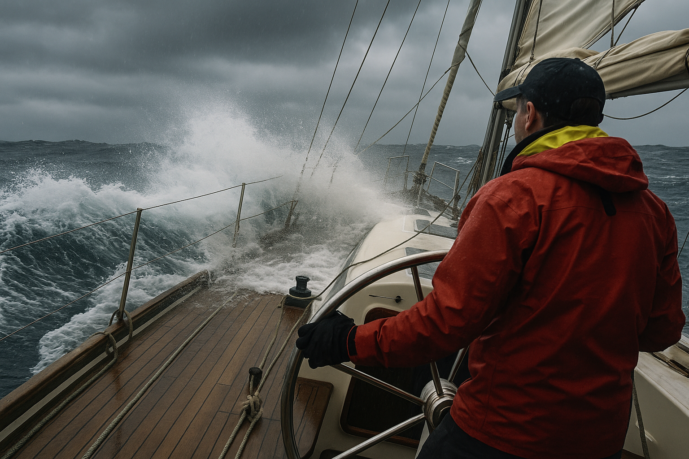
Understanding Heavy Weather: More Than Just Wind and Waves
Before a sailor can master the tactics for heavy weather, they must first master its definition. It is not a simple number on an anemometer or a category on a forecast. Heavy weather is a fluid concept, a dynamic intersection of vessel capability, crew condition, and the raw physics of the sea. True seamanship begins with understanding this complex relationship and learning to recognize the signs of deteriorating conditions long before they become a crisis.
Defining “Heavy Weather” for Your Vessel and Crew
The term “heavy weather” is entirely relative. What constitutes a challenging but manageable day for one vessel and crew could be a survival situation for another. Defining your own limits is the first and most critical step in safe passage-making.
- The Vessel’s Perspective: A 30-knot wind and its corresponding sea state will be felt very differently. A robust 50-foot ketch with a deep keel might handle such conditions with reefed sails and a sense of powerful purpose. The same wind in a 25-foot coastal sloop could be an overwhelming, gear-threatening ordeal, with waves that seem disproportionately large and dangerous. The boat’s size, displacement, hull form, and rig all dictate its comfortable operating envelope.
- The Crew as a Critical Factor: A vessel is only as strong as its crew. An experienced, well-rested team can manage difficult conditions with calm efficiency. However, introduce fatigue, seasickness, or fear, and the crew’s capacity for sound judgment and physical work diminishes rapidly. A Force 6 blow with a green crew can be more dangerous than a Force 8 with seasoned sailors. Morale is not a soft skill in a storm; it is a core safety component.
- Sea State vs. Wind Speed: High wind speeds are not the sole arbiters of danger. The nature of the waves, or sea state, is often the more critical threat. A long, rolling swell in 40 knots of wind in the open ocean can be more comfortable than 25 knots of wind in a confined channel with a steep, confused chop. Short, steep waves with a period of only a few seconds leave no time for the boat to recover between impacts and place immense stress on the hull, rig, and crew.
- Recognizing Your Limits: Every skipper must define their own “yellow” and “red light” conditions. This involves an honest assessment of the boat’s design, the crew’s experience, and personal risk tolerance. Recognizing when conditions are approaching or exceeding these pre-defined parameters is what separates proactive seamanship from reactive crisis management. The goal is to act early, reducing sail or altering course before the situation dictates your actions for you.
Reading the Signs: Proactive Weather Gnosis
Relying solely on a downloaded forecast is insufficient for the prudent mariner. Expert-level safety involves a deeper, more nuanced interpretation of the weather, blending modern technology with the timeless skill of reading the sky and the sea. This is a move from passive weather consumption to active, proactive weather gnosis.
- Interpreting Barometric Pressure: The barometer is one of the most reliable onboard predictors of weather. It is not the absolute pressure value that matters most, but the rate of change. A steady barometer indicates stable weather. A slow, steady fall suggests an approaching low-pressure system. However, a rapid drop—more than one millibar per hour—is a clear and urgent signal of a rapidly intensifying storm.
- Advanced Cloud Formation Analysis: The sky tells a story to those who know the language. High, wispy “mare’s tails” (cirrus clouds) are often the first harbingers of an approaching warm front, with deteriorating weather 12 to 24 hours away. The most dramatic indicator is the anvil-topped cumulonimbus cloud, the signature of a powerful thunderstorm cell that brings violent squalls, extreme wind shifts, and potentially lightning.
- Leveraging Modern Tools: Today’s sailor has access to an incredible suite of technology. GRIB (Gridded Information in Binary) files provide detailed wind, wave, and pressure data that can be downloaded via satellite or internet and overlaid on electronic charts. High-resolution satellite imagery reveals the structure and movement of weather systems in real time. Advanced weather routing software can analyze this data to suggest the safest and most efficient route around hazardous conditions.
- The Principle of Redundancy: Never trust a single source of information. The professional approach involves cross-referencing multiple data points. Compare the official government forecast with a GRIB file, check the live satellite image, look at your barometer, and then look out the window. When technology, official forecasts, and your own observations align, you can make decisions with a high degree of confidence.
The Physics of Dangerous Waves
To stay safe, one must understand the enemy. Dangerous seas are not a random chaos; they are governed by the laws of physics. Understanding these principles allows a sailor to anticipate and avoid the most hazardous conditions.
- Period, Height, and Steepness: A wave is defined by its height (from trough to crest) and its period (the time it takes for two successive crests to pass a fixed point). The relationship between these two creates its steepness. A long-period ocean swell might be 15 feet high but feel gentle because it is not steep. A 10-foot wave with a very short period is steep, sharp, and violent. It is the steepness, more than the height, that determines if a wave is likely to break.
- The Critical Danger of Breaking Waves: A breaking wave is the single greatest threat to a vessel at sea. When a wave’s steepness exceeds a critical ratio (approximately 1:7 height to length), its face collapses. This is no longer just moving water; it is a hydro-dynamic shockwave, a wall of immense energy capable of knocking down, rolling, or catastrophically damaging even a well-found yacht.
- Current Opposing Wind: One of the most reliably dangerous sea states occurs when a strong wind blows against a significant ocean current (e.g., wind from the north against the Gulf Stream’s northbound flow). The current effectively shortens the wavelength, causing the waves to “stack up” and become exceptionally steep and treacherous, often breaking in conditions where they otherwise wouldn’t. This effect is common in tidal races and over offshore banks.
- Shoaling Effects: As waves travel from deep water to shallower areas near a coastline or over a submerged bank, their energy is compressed into a smaller volume of water. They slow down, their height increases dramatically, and their period shortens. This “shoaling” effect is why waves that are harmless offshore can become violent, breaking surf near the coast, posing a major hazard to vessels making landfall in a storm.
The Art of Heaving-To: A Masterclass in Control and Stability
Of all the tools in a skipper’s heavy-weather arsenal, heaving-to is perhaps the most elegant and misunderstood. It is not simply stopping; it is a dynamic state of equilibrium, a controlled pause that transforms a vessel from a battered object into a stable platform. Mastering this technique provides a profound sense of control, offering respite for the crew and reducing strain on the rig and hull when conditions deteriorate.
The Theory: How Heaving-To Tames the Sea
Heaving-to is a finely balanced dance between sails and rudder. The primary goal is to stall the boat, positioning it at an angle of approximately 40 to 50 degrees off the wind, where it forereaches (moves forward) very slowly. This controlled state is achieved by creating opposing forces.
- The Balancing Act: A backed headsail (a jib or staysail held to windward) acts as a powerful brake, attempting to push the bow away from the wind. This is countered by the force of the main sail and the rudder, which is typically lashed to leeward, trying to turn the bow up into the wind. When these forces are balanced, the boat settles into a stable position.
- Creating a “Slick”: As the boat drifts sideways (makes leeway), its keel or hull creates a turbulent patch of water to windward. This “slick” disrupts the surface tension of the water and can effectively flatten the face of approaching waves, causing many to break before they reach the hull. The boat essentially creates its own small patch of calmer water.
- The Goal: The objective is not to stop completely, but to achieve a slow, stable drift. The vessel remains under control, making a knot or two of forward progress while sliding sideways. This provides a remarkably comfortable motion, allowing the crew to rest, make repairs, or simply wait for the storm to pass with minimal stress on all systems.
Step-by-Step Guide to Heaving-To
While the theory is universal, the execution is a precise maneuver. It should be practiced in moderate conditions so that it becomes second nature before you need it in a gale.
Preparing the Boat and Crew
Preparation is non-negotiable and should be completed before the maneuver begins.
- Secure Everything: Conduct a thorough sweep above and below decks. Lash down anchors, jerry cans, and anything on deck. Below, ensure floorboards, batteries, tools, and galley supplies are completely secured. In heavy seas, any loose object becomes a dangerous projectile.
- Brief the Crew: Gather everyone and explain the plan clearly. Assign specific roles for the maneuver. A calm, well-informed crew is a safe and effective crew. Ensure everyone understands the goal is to stabilize the boat, not to fight the storm.
- Gear Up: All crew on deck must be wearing full foul weather gear, a PFD (personal flotation device), and a harness with a tether. Jacklines should already be rigged and in use. This is not the time to be searching for safety equipment.
The Maneuver: Sloop/Cutter Rig
For a typical monohull, the process is methodical and calm.
- Reduce Sail: Before attempting to heave-to, reduce sail area to a manageable size appropriate for the conditions. This typically means a deeply reefed mainsail (or a trysail) and a storm jib or a partially furled, sturdy headsail.
- Tack the Boat: Turn the boat through the wind as if you are tacking, but instruct the crew not to release the working jib sheet.
- Sheet the Backed Jib: As the bow passes through the eye of the wind, the “old” jib sheet becomes the new windward sheet. Trim this sheet in tight. The sail will fill on the “wrong” side, effectively backing the sail and acting as a brake.
- Ease the Mainsheet: Ease the mainsheet until the mainsail luffs slightly but still retains enough power to counteract the backed jib. The goal is to prevent the boat from bearing away too far.
- Lash the Helm: With the sails balanced, turn the tiller or wheel to leeward (away from the wind) as if you were trying to sail upwind. Find the position where the rudder balances the forces of the sails and lash it securely in place. The boat should now settle into a stable heave-to position.
Adapting for Different Rigs and Hull Forms
- Ketches and Yawls: These rigs have an advantage. Often, they can heave-to beautifully using just a backed headsail and the mizzen sail, dropping the mainsail entirely. The mizzen provides excellent balance and keeps the stern pushed downwind, helping the bow stay angled into the weather.
- Multihulls: Catamarans and trimarans can also heave-to, but their light displacement and high windage mean they behave differently. They tend to drift faster and may require a drogue or significant sail adjustments to find a comfortable position. Because they do not heel, they don’t create the same kind of slick as a monohull.
- Full Keel vs. Fin Keel: Traditional full-keel boats are often champions of heaving-to. Their long keel provides immense directional stability, helping them track predictably and create an effective slick. Modern fin-keel boats are more nimble and can sometimes be trickier to balance. They may forereach more quickly or require more precise rudder and sail adjustments to find their sweet spot.
Fine-Tuning Your Heave-To Position
Heaving-to is not a “set it and forget it” tactic. It requires observation and small adjustments to achieve optimal stability and comfort.
- Finding the Sweet Spot: Every boat has a unique “groove.” You may need to make minor adjustments to the mainsheet or rudder angle to stop the boat from “sailing” out of the heave-to or falling off the wind too much. A few inches of sheet or a few degrees of rudder can make a world of difference.
- Monitoring Drift: Once stable, immediately check your GPS to determine your rate and direction of drift (your course and speed over ground). This is critical for situational awareness. You are not stationary; you are moving, and you must know where you are heading to avoid downstream hazards like shoals or shipping lanes.
- When to Heave-To: This is an excellent tactic for giving the crew a hot meal and much-needed rest, making a simple repair, waiting for daylight before making a difficult landfall, or simply letting the worst of a manageable gale blow through.
- When Not to Heave-To: In truly extreme, survival-level storms with large breaking waves, heaving-to can expose too much of the boat’s beam to the seas, risking a severe knockdown. It is also an extremely dangerous tactic if you are anywhere near a lee shore (a coastline downwind of you), as your sideways drift could put you onto the rocks. In these situations, more active tactics are required.
Beyond Heaving-To: A Toolkit of Heavy Weather Tactics
Heaving-to is a cornerstone of heavy weather seamanship, but it isn’t a universal solution. In certain conditions—such as when close to a lee shore or in truly survival-level storms—a different approach is required. An expert mariner has a full toolkit of strategies and understands when to deploy each one for maximum safety and control.
Forereaching: Making Controlled Headway
Forereaching, sometimes called “active heaving-to,” is a technique for making slow, controlled progress to windward in heavy seas. Instead of stalling the boat, the goal is to maintain just enough forward momentum to provide positive steerage and control. The technique typically involves sailing under a deeply reefed mainsail, a storm jib, or a combination of both, with the sails sheeted in to maintain a close-hauled angle to the wind.
This slow but steady progress (often just 1-2 knots) is invaluable in specific scenarios. Its primary application is to claw off a lee shore, where drifting backward or sideways is not an option. By forereaching, you can gain precious sea room and keep the vessel out of the surf zone. It is also a preferable tactic when you need to make slow, safe headway toward a nearby port of refuge without subjecting the boat and crew to the strain of actively beating into a gale.
Running Off: Controlled Sailing with Following Seas
Sailing downwind in a storm, or “running off,” may seem like an easier option, but it is one of the most demanding and high-concentration tactics a skipper can employ. This is not a passive ride; it requires constant, active helming to prevent a catastrophic loss of control. The boat is moving at high speed, often surfing on the face of large waves, and the potential for disaster is ever-present.
The primary dangers when running off include:
- Broaching: The most common risk. As the boat accelerates down a wave face, the rudder can lose its grip, causing the boat to slew sideways (beam-on) to the next oncoming wave, risking a knockdown.
- Surfing and Pitch-poling: Uncontrolled surfing can cause the bow to bury into the trough at the bottom of a wave. If the stern is then lifted by the wave’s crest, the boat can be flipped end-over-end in a terrifying maneuver known as a pitch-pole.
- Overwhelming Pooping Seas: A large wave breaking over the stern can flood the cockpit, damage hatches, and potentially sweep crew overboard.
The art of running off lies in active steering. The helmsperson must anticipate the vessel’s movement, steering skillfully on the wave faces to keep the stern square to the most dangerous crests. To mitigate the risks, sailors often deploy a drogue from the stern. This device acts like a brake, providing drag to slow the boat, prevent uncontrolled surfing, and greatly enhance directional stability, making the helmsperson’s job more manageable.
Drogue vs. Sea Anchor: A Critical Distinction
It is vital to understand the difference between these two pieces of equipment. A drogue is a speed-limiting device, typically shaped like a cone or a series of small parachutes on a line. It is deployed from the stern while the boat is actively sailing downwind (running) to provide drag and control. Its purpose is to slow the boat, not stop it.
A sea anchor, or para-anchor, is a much larger parachute-like device deployed from the bow. Its purpose is to stop the boat’s forward motion and hold the bow into the wind and waves, effectively turning the vessel into a stable, anchored platform. It is a stopping tactic, functionally opposite to a drogue.
Deploying a Sea Anchor or Para-Anchor
When conditions become too severe for running off, or when the crew is exhausted, deploying a sea anchor can be a vessel-saving maneuver. The theory is simple: the large parachute opens in the water, creating immense drag that holds the bow pointed directly into the oncoming waves. This allows the vessel to ride the seas bow-first, the strongest and most sea-kindly orientation, minimizing rolling and presenting the smallest target to breaking crests.
However, deploying and retrieving a sea anchor in a storm is a difficult and potentially hazardous operation that requires careful planning. The loads generated by a sea anchor in heavy seas are astronomical. Standard deck cleats are often not strong enough to handle the strain. A purpose-built system involving a bridle led to multiple, reinforced strong points on the hull (such as primary winches) is essential to distribute the load and prevent catastrophic failure of deck hardware. Chafe protection on the anchor rode is also absolutely critical.
Lying A-Hull: The Tactic of Last Resort
Let us be unequivocally clear: lying a-hull should be considered a survival-only tactic, to be avoided if any other option exists. It is not a controlled strategy but an admission that control has been lost. To lie a-hull, all sails are dropped and secured, the engine is off, and the helm is lashed, leaving the boat to its own devices in the tumultuous sea.
The extreme risk of this tactic is that the vessel will naturally tend to lie beam-on to the wind and waves. In this position, the boat presents its largest and most vulnerable profile to breaking seas. The chance of being rolled by a breaking wave, suffering a severe knockdown, or even a full capsize is exceptionally high. The violent motion can cause immense damage and injury.
There are only a few dire situations where lying a-hull becomes the only choice. These include a complete dismasting where there is no means to set any sail, or a total and irreparable failure of the steering system. In these worst-case scenarios, when you can no longer control the boat’s orientation to the waves, you are forced to endure and hope that the vessel’s inherent stability is sufficient to survive.
Proactive Seamanship: Preparation is the Cornerstone of Safety
The most sophisticated heavy-weather tactics are rendered useless if the vessel and crew are not prepared for the ordeal. The actions you take hours or even days before the wind and waves build are what truly define a successful outcome. Proactive seamanship isn’t just about reacting to a storm; it’s about methodically creating an environment of control, security, and resilience long before the first breaking wave arrives.
Preparing the Vessel for a Blow
Your boat is your sanctuary in a storm, but only if it’s been properly fortified. A vessel that is ready for heavy weather is one where every component has been inspected, secured, and optimized for survival. This preparation is divided into two critical zones: below decks and on deck.
Below Deck Integrity
The violent motion of a boat in a seaway can turn the most benign cabin into a scene of chaos. Anything not bolted down becomes a potential projectile, capable of causing injury or significant damage. The goal is to achieve total structural and stowage integrity.
- Secure Heavy Items: This starts with the fundamentals. Ensure floorboards are screwed down, not just resting in place. Confirm that batteries are immovably secured in their boxes. All heavy items—toolboxes, anchors, spare parts, canned goods—must be lashed down or stowed in deep, securely latched lockers.
- The “Boat-Quake” Test: A practical way to check your work is to imagine the boat being violently shaken and rolled past 90 degrees. Walk through the cabin and ask of every single item, “Where will this go in a knockdown?” If you can’t answer with certainty, secure it better.
- Storm Boards and Deadlights: Large windows and ports are points of vulnerability. A breaking wave can easily shatter acrylic or glass. Prepare and pre-fit storm boards (also called deadlights)—strong plywood or metal plates that can be bolted over windows from the outside to protect them. Know how to fit them quickly.
- Water Management Systems: Check that your primary electric bilge pumps are working and that the float switches are clean and operational. Crucially, know the location of your manual bilge pump and ensure its handle is readily accessible. On deck, pour a bucket of water into the cockpit to confirm all scuppers are clear and draining rapidly.
On-Deck Readiness
The deck is the most exposed area of the boat, and it must be transformed from a living space into a lean, efficient, and secure working platform. The principle here is simple: less is more.
- Pre-rig Storm Sails: Do not wait until you’re battling 40-knot winds to rig your storm sails. If a serious blow is forecast, rig the storm jib and consider setting up the trysail on its separate mast track. This makes the transition from working sails to storm canvas a controlled, low-stress evolution.
- Clear the Decks: Everything that can be washed overboard must be taken below or stored in a secure deck locker. This includes fuel cans, dinghies (if not securely stowed in chocks), solar panels, kayaks, and even winch handles. A clear deck minimizes risk to the crew and prevents lost gear from becoming floating debris.
- Rigging and Hardware Inspection: Conduct a meticulous visual inspection of the entire rig. Check for broken strands in wires, hairline cracks in swage fittings, and signs of movement or wear around chainplates. Ensure cotter pins are taped. Inspect stanchions, pulpits, and lifelines for any weakness.
- Set Up Jacklines: Rig your jacklines before you need them. These strong webbing lines, running from the cockpit to the bow, are the lifelines your crew will clip their tethers to. Ensure they are rigged with minimal slack and lead to strong, dedicated attachment points.
Preparing the Crew for the Ordeal
A well-prepared boat is only half the equation. The human element—the crew’s physical and mental state—is often the deciding factor. A tired, cold, dehydrated, or seasick crew makes poor decisions. Preparation focuses on preserving their strength and cognitive function.
- Food and Hydration: Before the weather deteriorates, prepare a hot, easily digestible, high-energy meal. While conditions are still manageable, also prepare snacks that can be eaten with one hand—think granola bars, sandwiches in zip-top bags, or fruit. Keep a thermos of hot water or soup in the cabin. Hydration is non-negotiable; ensure water bottles are full and accessible to everyone to prevent dehydration, which severely impairs judgment.
- Establish a Watch System: Fatigue is the enemy of good seamanship. Establish a clear watch-keeping schedule that ensures everyone gets adequate rest. Shorter watches (e.g., two or three hours) are often more effective in heavy weather than longer ones, as they prevent deep exhaustion from setting in.
- Mandate Safety Gear Early: The rule should be simple: if conditions are building, harnesses and tethers are mandatory for anyone on deck or in the cockpit. Do not wait for the first big wave to wash through the cockpit. This is a non-negotiable command from the skipper.
- Manage Seasickness: Address seasickness proactively. Encourage crew to take medication well before the onset of bad weather, as it’s far less effective once nausea has begun. Acupressure bands and ginger can also be helpful for some. A seasick crew member is not only miserable but also a liability, so prevention is key.
The Heavy Weather Mindset: Calm, Confident Command
Ultimately, safety at sea is a state of mind. The skipper’s demeanor sets the tone for the entire vessel. Panic is contagious, but so is calm competence. Cultivating the right mindset is the final and most crucial layer of preparation.
The psychology of managing a vessel in a storm involves accepting the reality of the situation while focusing on what can be controlled. Acknowledge fear and fatigue in yourself and your crew, but do not let them dictate your actions. The skipper’s primary role is to project an aura of calm, methodical control. Your crew looks to you for leadership; if you are calm, they are more likely to remain calm and effective.
This confidence comes from making clear, conservative, and early decisions. Don’t wait until the situation is critical to reef the sails or heave-to. Act preemptively. The sea is unforgiving of hesitation. Finally, the hallmark of an expert skipper is knowing the limits—not just the theoretical breaking strain of the rigging, but the real-world limits of the boat’s handling characteristics and, more importantly, the physical and emotional endurance of the crew. Pushing either beyond its limit is the surest path to danger. True seamanship lies in respecting those boundaries and always keeping a margin of safety in hand.