Está preparado para um transatlântico? Uma lista de verificação da preparação mental e emocional
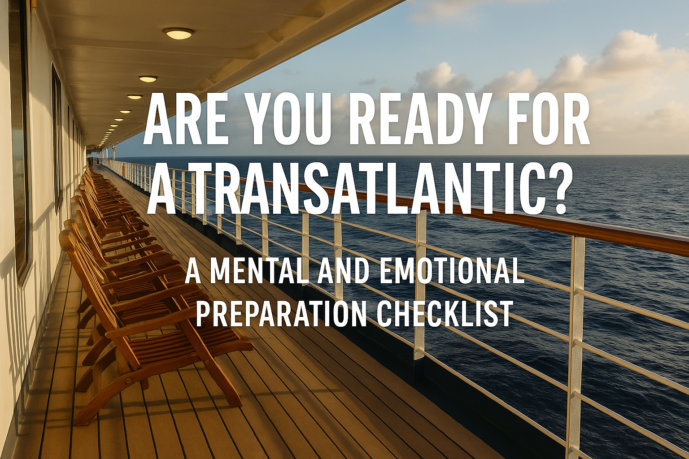
Beyond the Packing List: Gauging Your True Transatlantic Readiness
The Dream vs. The Doubt
The idea of a transatlantic crossing is steeped in a certain kind of magic. It conjures images of elegant decks, the endless blue horizon, and the luxury of uninterrupted time. It’s a throwback to a golden age of travel, a deliberate and grand way to move across the world. You’ve pictured yourself with a book in a deck chair, the crisp sea air on your face, feeling the gentle rhythm of the ship as it charts its course through the vast, open ocean. It is, in every sense, a romantic and compelling dream.
And yet, once the booking is confirmed and the initial excitement settles, another feeling often creeps in. A quiet, persistent whisper of doubt. What if the endless blue starts to feel less like freedom and more like isolation? What if the weather turns, and the gentle rhythm becomes a relentless rocking? What if you, a person used to a life of constant connection and activity, find yourself simply… bored? If you’re feeling this blend of keen anticipation and quiet apprehension, please know you are in good company. This duality is not a sign of a poor decision; it is the hallmark of a thoughtful traveler about to embark on a truly significant journey.
Why Your Mental State Matters More Than Your Suitcase
A transatlantic crossing is unlike almost any other form of travel. It is not a series of destinations connected by a ship; the ship *is* the destination. The journey itself is the main event. This makes it a unique experience—a journey within a journey. While you are physically crossing an ocean, you are also being given a rare and uninterrupted space for reflection, rest, and reconnection with yourself. How you navigate this internal landscape is just as important as navigating the ship’s decks.
You can pack the perfect wardrobe, the most engaging books, and all the right chargers, but if your mind is fraught with unexamined anxiety, the quality of your experience will be diminished. Your emotional and mental preparedness will ultimately dictate whether the long sea days feel like a gift or a sentence. It is the filter through which you will experience every sunrise, every meal, and every quiet moment. The goal, therefore, isn’t to pretend these anxieties don’t exist. It’s not about eliminating fear. It’s about understanding it, preparing for it, and transforming it from an obstacle into a part of the rich, complex tapestry of the voyage itself.
The Big Four: Confronting Common Transatlantic Anxieties
Even the most seasoned traveler can feel a flutter of apprehension before a transatlantic crossing. It’s a voyage that taps into something ancient and profound within us. These anxieties aren’t a sign you’re not ready; they are a sign you understand the scale of the undertaking. Let’s acknowledge these common fears head-on, not to banish them, but to understand them, so you can move through them.
Fear 1: The Vastness and the Weather
There is a moment, a day or two out from shore, when you look out in every direction and see nothing but the seamless union of sea and sky. This can be awe-inspiring, but it can also trigger a primal fear. The sheer, uninterrupted vastness of the Atlantic can make one feel incredibly small and exposed. It’s a humbling, and sometimes unsettling, confrontation with nature in its purest form.
This feeling is often compounded by the question: “What if the weather turns?” The thought of being confined to your cabin, listening to wind and waves, while battling seasickness is a potent source of anxiety. It’s true that modern ocean liners are marvels of engineering, equipped with advanced stabilizers and weather-tracking technology that make them extraordinarily safe. But this anxiety isn’t really about statistics; it’s about the feeling of surrendering control. It’s about accepting that for a short time, you are a guest in a powerful, unpredictable environment. Acknowledging this vulnerability is the first step toward finding your peace within it.
Fear 2: Isolation and Disconnection
In our hyper-connected world, the idea of being truly “unplugged” can feel less like a luxury and more like an amputation. The intermittent and often slow satellite internet at sea is a reality that forces a disconnect. The anxiety here is twofold: you worry about what you’re missing back home—the family group chats, the work emergencies, the daily news cycles—and you worry about the void this disconnect creates.
This can lead to a paradoxical sense of loneliness. You may be surrounded by a thousand fellow passengers, yet feel utterly alone without the familiar digital tether to your support system. The distance feels immense, and the worry that something could happen to a loved one while you are unreachable is a very real and valid concern. This journey asks you to trust that the world will continue without your constant input and to find connection not through a screen, but with your immediate surroundings and, most importantly, with yourself.
Fear 3: The Specter of Boredom
“But what will I actually do for ten days straight?” This is perhaps the most frequently asked question, and it betrays a deep-seated anxiety of modern life: the fear of unstructured time. For those of us whose lives are dictated by calendars, deadlines, and endless to-do lists, a week of open-ended days can feel daunting, even terrifying. The absence of obligation can create a vacuum that the mind rushes to fill with worry.
The fear isn’t just about being bored; it’s about the pressure to use this unique time “correctly.” There’s an anxiety of not “making the most” of the voyage, of failing to have the profound, life-changing experience you imagined. This pressure to be constantly engaged, entertained, or enlightened can be exhausting. A transatlantic crossing challenges the very notion of productivity, inviting you to simply exist without a goal, an agenda, or a measure of success.
Fear 4: Navigating Onboard Social Dynamics
A ship is a temporary, floating village, and with that comes a unique set of social pressures. For the introverted, the prospect of forced small talk at assigned dinner tables can be a source of dread. For the extroverted, there can be an opposing anxiety about finding their “tribe” or making meaningful connections. The question looms: “Will I have to make friends? What if I don’t want to?”
There is also the fatigue of being perpetually “on.” From greeting the same faces on the promenade deck to interacting with staff and fellow guests, it can feel like a performance you can’t escape. You might worry about sharing close quarters with strangers for an extended time, navigating different personalities and social cues. The key is to remember that you are in control of your social energy. Giving yourself permission to retreat is just as important as knowing how to engage.
Your Mental and Emotional Preparation Checklist
Once the practicalities are sorted, the real preparation begins. This isn’t about what you pack, but how you frame the entire experience. The following checklist is designed to help you build the mental resilience and emotional flexibility needed to transform your transatlantic crossing from a simple trip into a truly profound journey.
Mindset Shift 1: Embrace the Disconnect as a Feature, Not a Flaw
Perhaps the single greatest challenge—and opportunity—of a transatlantic voyage is the enforced separation from our hyper-connected world. Approaching this with the right mindset is critical.
The Digital Detox You Didn’t Know You Needed
The first step is radical acceptance: ship internet will not be like your home broadband. It will likely be slower, less reliable, and more expensive. Instead of fighting this reality, prepare to embrace it as a core part of the experience.
- Set expectations beforehand: Inform family, friends, and colleagues that you will be largely unreachable. Set a clear out-of-office message explaining you’ll have limited or no access to email. This relieves you of the guilt of not responding and manages others’ expectations.
- Prepare for offline life: Download everything you might want—music playlists, podcasts, audiobooks, films, and e-books—before you board.
- Savor the benefits: The reward for this disconnect is immense. You’ll find yourself more present, noticing the subtle shifts in the sea and sky. Conversations may feel deeper. Your mind, free from the constant ping of notifications, can finally unwind and achieve a rare state of clarity.
Redefining “Productivity”
For many of us, our self-worth is tied to our daily accomplishments. The unstructured time of a sea voyage can trigger an anxiety of “wasting time.” It’s essential to give yourself permission to be gloriously unproductive.
On a transatlantic, watching the waves for an hour is not procrastination; it’s participation. Reading a novel in a deck chair is not laziness; it’s immersion. The goal shifts from doing to being. Your task is not to fill every moment with activity, but to simply inhabit the moment you are in. This is the ultimate luxury.
Mindset Shift 2: Build Your Onboard Routine
While embracing unstructured time is key, creating a gentle, flexible rhythm for your days provides a comforting anchor that can prevent you from feeling adrift.
The Power of a Gentle Structure
A routine at sea isn’t a rigid timetable but a series of personal rituals that provide shape and comfort to your day. It combats the potential for aimlessness and decision fatigue. Consider creating a loose rhythm that feels good to you. For example:
- A morning walk around the promenade deck with a cup of coffee.
- An hour of reading in a quiet lounge after lunch.
- A visit to the gym or spa in the late afternoon.
- A pre-dinner cocktail at your favorite onboard bar, watching the sun set.
This simple structure helps punctuate the day, giving you a sense of purpose without the pressure of a schedule.
Packing Your “Comfort Kit”
Think beyond your wardrobe and consider what items will soothe and ground you. This isn’t about entertainment; it’s about packing tools for your emotional well-being. Your comfort kit is a small collection of familiar things that can regulate your mood and make your stateroom feel like a sanctuary.
This could include a well-loved paperback, a specific journal and pen that feels good in your hand, a pre-downloaded playlist of calming music, a favorite brand of herbal tea, or a familiar scarf. These items are tactile links to home and self, serving as your personal toolkit for managing moments of anxiety or loneliness.
Mindset Shift 3: Practice Mindfulness and Self-Compassion
Feelings of anxiety or melancholy may surface during the voyage. The goal is not to prevent these feelings, but to have the tools to meet them with grace and understanding.
Acknowledge, Don’t Fight, the Feeling
When a wave of anxiety hits, our instinct is often to resist it, which can amplify the feeling. Instead, try to simply observe it without judgment. Name it: “I am noticing a feeling of anxiety right now.” This simple act creates distance and lessens its power.
For moments of overwhelm, a simple grounding exercise can be incredibly effective. Try the 5-4-3-2-1 method:
- Acknowledge 5 things you can see around you.
- Acknowledge 4 things you can touch.
- Acknowledge 3 things you can hear.
- Acknowledge 2 things you can smell.
- Acknowledge 1 thing you can taste.
This technique pulls your attention out of your anxious thoughts and back into your physical body and immediate environment.
The Art of Journaling at Sea
A journal can be your most trusted confidant on a long voyage. It’s a private space to process the unique experience in real-time. Use it to document the changing color of the water, vent frustration about a spell of bad weather, capture a snippet of an interesting conversation, or record a moment of unexpected joy. Externalizing your thoughts and feelings onto the page can make them feel far more manageable.
Mindset Shift 4: Set Your Social Boundaries
A ship is a small, floating village, and navigating the social landscape can be a source of anxiety for many. The key is to manage your social energy intentionally.
Your “Social Thermostat”
Give yourself explicit permission to control your own social temperature. You are not obligated to be “on” all the time. If you feel like having a quiet dinner and retreating to your cabin with a book, do it without guilt. If you’re craving connection, seek it out. Learning to recognize and honor your own needs for solitude and connection is crucial to avoiding social burnout and enjoying the journey on your own terms.
Conversation Starters for the Socially Anxious
If the thought of striking up a conversation feels daunting, arm yourself with a few simple, low-pressure questions. Remember, you share a powerful, unique context with every other passenger.
- “Is this your first crossing?”
- “What’s been the most surprising thing about the journey so far?”
- “Have you found a favorite spot on the ship yet?”
- “What’s the best thing you’ve eaten so far?”
Most people are in the same boat—literally and figuratively—and are happy to share a brief, friendly exchange. It doesn’t have to be a deep conversation; a simple, pleasant interaction can be enough.
Reframing the Journey: From Ordeal to Opportunity
Finding Awe in the Immensity
The very vastness that can spark our primal fear is also the source of the journey’s most profound beauty. The human mind struggles to comprehend an unbroken horizon, a world composed entirely of water and sky. Instead of resisting this feeling of smallness, you can learn to lean into it. Consider it an invitation to witness the planet on a scale few ever experience, to feel the gentle curve of the Earth in the endless arc of the sea.
The key is to shift from a passive passenger to an active seeker of wonder. Make it a gentle, daily practice to connect with your environment:
- Witness a sunrise over the open ocean. It is an event of profound stillness, a silent, slow wash of color across a canvas that feels truly infinite.
- Scan the horizon not for land, but for life. The sudden spray of a whale’s blow or the joyful arc of a dolphin pod breaking the surface is a thrilling reminder that you are a visitor in a thriving, wild world.
- Stay on deck well after sunset. Far from the light pollution of cities, the night sky reveals its true, staggering depth. Constellations become brilliant, and the Milky Way emerges as a luminous cloud you can almost touch.
The Crossing as a Rite of Passage
A transatlantic crossing is more than a method of transport; it is a demarcation in time. For centuries, these voyages have served as a rite of passage, a definitive break between an old life and a new one. In our hyper-connected world, such a profound pause is nearly extinct. This journey offers you that rare gift: a space between worlds where you can process where you’ve been and contemplate where you are going, free from the constant pull of daily obligations.
This is the true human element of the voyage. It’s the quiet understanding that by disconnecting from the world, you are reconnecting with yourself. The anxieties you prepared for, the boredom you feared, the solitude you navigated—these are not obstacles to be overcome, but elements of a transformative process. You have the chance to emerge on the other side not just in a new place, but as a subtly different person, one who has looked inward and found a renewed sense of perspective.
Are You Ready? A Final Self-Assessment
So, are you truly ready? The answer doesn’t lie in a feeling of complete fearlessness. If you’re waiting for all anxiety to vanish, you’ll wait forever. True readiness is the quiet confidence that you are prepared to meet your fears, armed with self-awareness and compassion. It is the willingness to sit with discomfort and the curiosity to see what lies on the other side of it.
This journey asks for your presence, not your perfection. If you can look at the vast, open sea and embrace the uncertainty it represents, if you can welcome the quiet moments as an opportunity for introspection, then you are more than ready. The voyage is waiting for you.