Homem ao mar! Porque é que praticamos exercícios
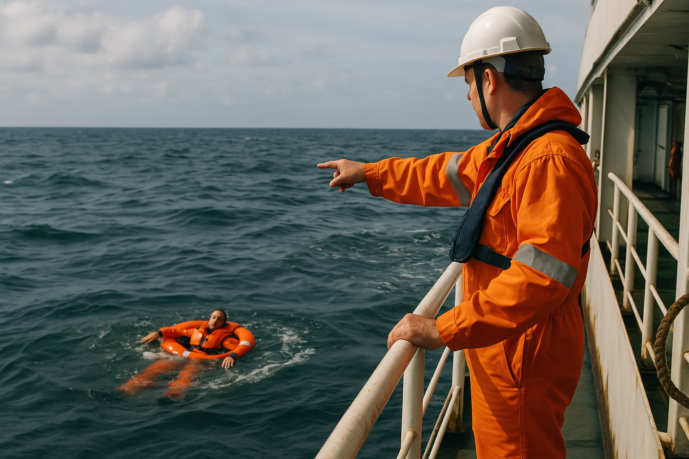
The Unthinkable Moment: What “Man Overboard” Really Means
More Than Just a Nautical Term
The phrase “Man Overboard” is one of the most sobering in any mariner’s vocabulary. Far from being a dramatic line in a film, it signals a genuine, time-critical emergency that demands an immediate, practiced, and unwavering response. It can happen in a moment—a slip on a wet deck, an unexpected wave, or a moment of distraction. One second, everyone is safe aboard; the next, a life is in peril. In these situations, there is no time for confusion or hesitation. Every action, and every second, counts.
The Clock is Ticking: The Real Dangers
Once a person is in the water, a series of immediate and compounding dangers begin. The environment that seems so beautiful from the deck of a boat becomes incredibly hostile. The primary threats are swift and unforgiving:
- Hypothermia: Even in water that feels pleasantly warm, the body loses heat 25 times faster than in air. This rapid cooling can quickly impair physical coordination and cognitive function, making it difficult for the person to assist in their own rescue.
- Shock and Exhaustion: The initial shock of unexpectedly hitting cold water can cause an involuntary gasp, potentially leading to water inhalation. The physical effort required to stay afloat, fight currents, and remain visible is immense and can lead to rapid exhaustion.
- Visibility: A person’s head is a very small target in a vast expanse of water. From the boat, factors like sun glare, sea spray, and the crests and troughs of even small waves can make it incredibly difficult to maintain visual contact.
- Separation from the Vessel: A boat under power or sail moves away from a person in the water with surprising speed. Within a minute, a vessel can be hundreds of feet away, turning a potential recovery into a difficult search operation.
A Scenario No One Wants, But Everyone Must Prepare For
No one begins a day on the water expecting to face a man overboard situation. It is the definition of an unthinkable event. However, in the world of professional seamanship, preparedness is not driven by fear, but by responsibility. We do not dwell on the “what if,” but instead focus on the “how to.” Acknowledging the seriousness of an MOB event is the first step toward neutralizing its danger. It is this understanding that transforms preparation from an optional task into a non-negotiable pillar of our safety culture, ensuring that if the unthinkable happens, our response is automatic, efficient, and effective.
Our Commitment to Safety: The Anatomy of Our MOB Drills
It’s Not If, It’s When: Our Proactive Safety Culture
On our vessels, safety is not a chapter in a manual; it is the foundation of our operational culture. We view preparedness not as an obligation, but as a professional ethic. For this reason, Man Overboard (MOB) drills are a core component of our standard operating procedures, practiced with the same regularity and seriousness as any other critical aspect of seamanship. We don’t wait for a calm, sunny day. Our crew runs these drills in a variety of conditions, understanding that emergencies do not respect convenience. This proactive mindset is ingrained in every crew member from their first day, ensuring that our commitment to safety is a living, breathing part of every voyage.
The Drill in Action: A Coordinated Response
A successful MOB recovery is a symphony of precise, immediate, and coordinated actions. Panic is the enemy of execution, which is why our drills break down the procedure into distinct, rehearsed steps. Each crew member knows their role, allowing the team to function as a single, efficient unit under pressure. Here is what our practice looks like in motion:
Step 1: Immediate Alert
The first and most vital action is the “Yell and Point.” The moment someone sees a person go overboard, they shout “Man Overboard!” at the top of their lungs and point directly at the person in the water. This spotter does not take their eyes or their finger off the person for any reason. This simple act provides a constant visual reference for the helm and crew, which is invaluable as the boat begins to maneuver.
Step 2: Mark the Position
Simultaneously, another crew member’s immediate duty is to press the MOB button on the vessel’s GPS. This action instantly saves the exact coordinates of the incident. While the human eye can lose track of a person in the waves, the GPS provides a digital breadcrumb trail, giving us an unerring point to return to, day or night.
Step 3: Deploy Flotation and Markers
The next priority is to get flotation and visibility aids into the water near the person. This can include a life ring, a throwable cushion, or, ideally, a specialized marker like a dan buoy, which has a tall flag and a light. The goal is twofold: to provide the person with something to hold onto, conserving their energy, and to create a much larger, more visible target for us to spot as we return.
Step 4: Execute the Recovery Maneuver
Simply turning the boat around is inefficient and can lead to losing sight of the person. We practice specific, proven maneuvers like the Williamson Turn or the Quick-Stop method. These are designed to bring the vessel back to its starting point quickly and under full control, approaching the person from downwind to ensure a safe and slow final approach without running them over.
Step 5: The Recovery
Getting the person safely back on board is the final and most physically demanding step. A tired, cold person often cannot help. We practice multiple methods using specialized equipment, such as the Lifesling, which allows us to winch a person aboard, or a dedicated block and tackle system. The method used depends on the sea state and the condition of the individual, and practicing these techniques ensures we can perform them smoothly when it matters most.
Meet “Oscar”: Our Practice Dummy
To conduct these drills with true-to-life realism, we enlist the help of a very important, albeit silent, member of the team: “Oscar.” In maritime tradition, “Oscar” is the name given to the weighted dummy we use to simulate a person in the water. He is heavy enough to mimic the dead weight of an exhausted or unconscious individual, allowing us to practice the physical recovery without endangering a real person. Using Oscar lets us test not only our teamwork and maneuvers but also the load-bearing capacity and proper function of our recovery equipment. He is an indispensable tool in our pursuit of genuine preparedness.
Beyond the Checklist: Why Practice Makes Permanent
Building Muscle Memory to Beat Panic
In a genuine emergency, the human brain reacts with a flood of adrenaline. This primal response, while designed for survival, can easily lead to panic, mental freezing, or flawed decision-making. A checklist is a valuable guide, but it is of little use if one is too overwhelmed to read it. This is where the true value of practice reveals itself.
Through regular and repeated drills, we train beyond simple knowledge. We build instinct. The goal is to create muscle memory, where the correct sequence of actions becomes an automatic, ingrained response. When a real “Man Overboard” call is made, our crew doesn’t have to stop and think; they act. This drilled-in proficiency ensures that even under the immense pressure of a real-world crisis, the response is swift, correct, and decisive.
Forging a Cohesive Team
A successful recovery is a coordinated effort, a symphony of precise actions performed in unison. It is not the responsibility of a single person, but of the entire crew working as one. Our drills are as much about communication and teamwork as they are about individual tasks. During practice, each crew member learns not only their own role but also how it fits into the larger operation.
The helmsman knows the recovery turn, the spotter understands how to communicate the victim’s position, and another crew member is already deploying recovery equipment. This shared understanding, forged through practice, eliminates confusion and hesitation. It creates a seamless and efficient team that can execute a complex procedure with quiet confidence and clarity.
Testing Our Gear, and Ourselves
Practice is the ultimate quality control for both our crew and our equipment. A safety plan is only as strong as the gear used to execute it. By regularly deploying our life rings, dan buoys, and recovery slings, we do more than just practice the motions; we conduct a real-world systems check.
These drills allow us to confirm that every piece of safety equipment is in perfect working order, that it is stowed for immediate access, and that it performs as expected. We might discover a line that is prone to tangling or a buckle that is stiff. Finding and resolving these small issues in a controlled drill setting ensures they do not become critical failures when lives are on the line. It is a commitment to ensuring that we, and our tools, are always prepared.
For Every Boater: Why You Should Practice Too
Your Crew is Your Family and Friends
While our crew is bound by professional duty, your crew is often bound by something even more profound: family and friendship. When you take the helm, you accept a quiet, serious responsibility for every person on board. They place their trust in your judgment and skill. Honoring that trust means being prepared not just for a perfect day on the water, but for the unexpected moment when their safety depends entirely on your readiness. A Man Overboard drill is more than a procedure; it’s a plan to protect the people you care about most.
From Anxiety to Confidence
There is a subtle anxiety that can accompany the responsibility of being a captain—a quiet “what if?” in the back of the mind. The most effective way to address this is not to ignore it, but to confront it with preparation. The first time you successfully run a recovery drill, something remarkable happens: uncertainty is replaced by a clear, practiced plan. This transformation from anxiety to confidence is palpable. It allows you to relax more deeply, to be more present, and to find greater joy in your time on the water, knowing you are equipped to handle a critical situation with competence rather than panic.
Simple Steps to Start Your Own Drills
Integrating safety drills into your routine doesn’t need to be intimidating. It’s an empowering process that can be started with simple, manageable steps. The goal is to build a foundation of familiarity and skill. Here is how you can begin:
- Create your own “Oscar.” You don’t need a professional-grade dummy to practice. A large fender, a cushion, or a spare life vest tied to a short line makes an excellent stand-in. It’s visible, it floats, and it provides a clear target for your recovery maneuvers.
- Start at the dock. Before you even cast off the lines, walk through the entire procedure. Talk it out with your crew. Who will be the spotter? Who will be responsible for throwing the flotation device? Who will press the MOB button on the GPS? Clarifying roles in a calm environment is the essential first step.
- Practice in calm conditions. Your first on-water drills should be in a protected, calm area with minimal traffic. The objective is to learn the sequence and the feel of the boat’s handling during a recovery turn without the added stress of wind and waves.
- Assign a role to everyone. Every person on board can participate. Even a young guest can be the designated spotter, tasked with the critical job of pointing at the “person” in the water without ever taking their eyes off them. This gives everyone a sense of purpose and reinforces that safety is a shared responsibility.
Our Promise: A Foundation of Professionalism
More Than a Drill, It’s Our Mindset
The procedures we’ve detailed, from the immediate alert to the final recovery, are more than just items on a safety checklist. They are the tangible expression of a deeply ingrained, all-encompassing safety-first philosophy. This mindset is the foundation upon which our entire service is built. We believe that true professionalism at sea is not defined by the calm days, but by the readiness for the challenging ones. Our rigorous and continuous training is a fundamental commitment to you, ensuring that every member of our crew operates with precision, confidence, and an unwavering focus on your well-being.
Peace of Mind on Your Voyage
We share these details not to cause concern, but to offer genuine assurance. When you are on the water with us, your primary role is to relax, explore, and create lasting memories. Our role is to manage every detail, seen and unseen, that contributes to a seamless and secure experience. Our commitment to practicing for the unthinkable means you don’t have to think about it. You can feel the sea spray, watch the coastline drift by, and enjoy the company of your companions with the quiet confidence that you are in the hands of a crew that is prepared for anything. This is the ultimate luxury we offer: the peace of mind to be fully present in the moment.