Navegando na noite: Um guia para uma navegação nocturna segura e mágica
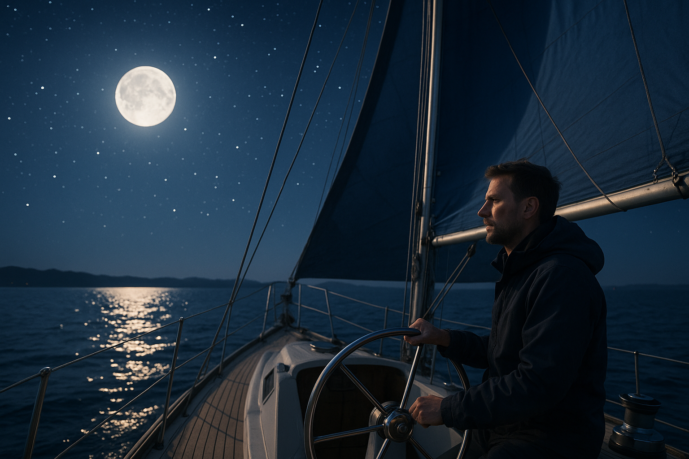
The Allure and Anxiety of the Darkened Sea
Acknowledging the Fear: What Makes Night Sailing Intimidating?
If the thought of sailing after sunset sends a shiver of anxiety down your spine, you are not alone. It’s a natural and sensible reaction. For aspiring and even seasoned sailors, the transition from day to night on the water is a profound shift that engages a completely different set of skills and senses. Acknowledging the source of this apprehension is the first step toward overcoming it.
- The loss of visual reference points: During the day, you navigate with a constant awareness of landmasses, channel markers, and other boats. At night, these familiar guides dissolve into an inky blackness. Your world shrinks to the pool of light on your deck, and your ability to judge distance and speed by sight is severely compromised.
- Fear of unseen obstacles: The sailor’s mind can conjure a host of “what ifs” in the dark. What about a semi-submerged shipping container, a large piece of driftwood, an unlit fishing buoy, or another vessel running without lights? The fear of a sudden, unseen collision is a primary source of anxiety.
- The feeling of isolation: As the shoreline lights fade, a profound sense of solitude can set in. You are a small, self-reliant crew on a vast and indifferent sea. This feeling can be both peaceful and deeply unnerving, amplifying your sense of vulnerability.
- Mental and physical fatigue: Staying vigilant in the dark is demanding. Your eyes strain to interpret distant lights, and your mind works harder to process information from instruments. This heightened state of alert, combined with the natural dip in your circadian rhythm, can lead to exhaustion more quickly than during the day.
Discovering the Magic: Why It’s an Unforgettable Experience
Yet, for every ounce of anxiety, there is a pound of pure magic waiting to be discovered. The sailors who push through their initial fears are rewarded with experiences that are simply unavailable under the sun. It’s in the darkness that the sea reveals some of its most breathtaking secrets.
- The breathtaking celestial display: Away from the light pollution of land, the night sky comes alive. The Milky Way paints a brilliant stroke across the heavens, constellations are sharp and clear, and shooting stars frequently dash across the expanse. Steering your boat by the shimmering path of a full moon on the water is an experience of unparalleled beauty.
- The tranquility and profound sense of peace: With the distractions of the day gone, a deep calm settles over the water. The sounds of the world are reduced to the gentle gurgle of your wake, the whisper of wind in the sails, and the rhythmic breathing of the ocean itself. It is a meditative, deeply peaceful state.
- Experiencing the ocean’s life in a new way: The sea is anything but asleep at night. You might witness the ethereal green or blue glow of bioluminescent plankton churning in your wake, creating a magical, glowing trail behind the boat. A pod of dolphins might appear, their silver bodies catching the moonlight as they race alongside you.
- The deep satisfaction of building new skills and confidence: Successfully completing your first night passage is a landmark achievement. It’s a testament to your preparation, skill, and courage. The confidence gained from navigating safely through the darkness is immense and transforms your relationship with sailing forever.
Shifting Your Mindset: From Fear to Confident Preparedness
The journey from anxiety to exhilaration is not about eliminating fear, but about transforming it. The key to this transformation is understanding that preparation and knowledge are the ultimate antidotes to fear. Every concern you have—from collision to getting lost—can be systematically addressed with the right equipment, procedures, and practice.
Instead of viewing night sailing as a daunting obstacle, begin to frame it as the next level of your seamanship. It’s an opportunity to learn to trust your instruments, sharpen your senses, and develop a more intuitive connection with your vessel and the marine environment. The rest of this guide is dedicated to giving you the practical tools and knowledge to turn apprehension into confident anticipation.
Pre-Voyage Prep: Setting Yourself Up for Success Before Sunset
The difference between a stressful night sail and a magical one is almost always determined before the sun even dips below the horizon. Meticulous preparation is the foundation of confidence. By methodically checking your vessel and your personal gear, you transform the unknown into the familiar, ensuring that when darkness falls, your only focus is on the beauty and challenge of the sail, not on preventable problems.
The Boat Checklist: Night-Specific Systems
Before you cast off, a thorough walkthrough of the boat’s key systems is non-negotiable. Your vessel is your partner in this adventure, and you need to ensure it’s ready for its nighttime duties. This check is best done in the daylight, when you can easily spot any issues.
Lighting Systems Check
Your lights are your voice in the dark, communicating your presence, status, and direction to other vessels. A failure here can be dangerous. Systematically test every single one:
- Navigation lights: Confirm your red (port), green (starboard), and white (stern) lights are all bright and functioning correctly. Check for corroded connections or fogged lenses.
- Steaming and Masthead/Anchor lights: Flip the switch for your masthead tricolor (if equipped) or your separate steaming light and anchor light. If possible, have someone view them from a distance to ensure they are visible.
- Deck and Spreader Lights: While you’ll want to use these sparingly to protect night vision, confirm they work. You’ll be grateful for a reliable deck light if you need to perform a sail change or check on rigging.
- Compass and Instrument Backlighting: Ensure your binnacle compass light is working and that all essential instrument displays have adjustable, functioning backlights. A dim, red glow is ideal.
Navigation and Electronics
Your electronic aids are powerful allies at night, but only if they are properly set up and functioning. Don’t wait until you’re in the dark to discover a problem.
- Night Mode: Switch your chartplotter, GPS, and any other screens to their “night mode” or “dusk” setting. This typically changes the background to black and dims the display to protect your night vision.
- System Confirmation: Confirm that your radar is operational and that your AIS (Automatic Identification System) is both receiving and transmitting. These are your primary tools for seeing and being seen by commercial traffic.
- VHF Radio Check: Perform a radio check on a non-emergency channel to ensure you can transmit and receive clearly. Have key channels, like VHF 16 (emergency) and 13 (bridge-to-bridge), on standby.
Deck and Cockpit Readiness
A tidy ship is a safe ship, and this is doubly true at night. What is a minor inconvenience in daylight becomes a serious trip hazard in the dark.
- Clear the Decks: Coil all lines neatly and ensure walkways are completely clear of clutter. Stow fenders, buckets, and any other loose items that could trip someone up.
- Prepare for Maneuvers: If there’s any chance you’ll need to reef, it’s wise to pre-run the reefing lines so they are ready to go. Think through any sail changes you might make and prepare the necessary sheets and halyards.
- Secure Everything: Do a final sweep above and below deck. Secure cabinet doors, lock down floorboards, and ensure heavy items are properly stowed so they won’t go flying if the boat heels or hits a wave.
The Personal Gear Checklist
Just as the boat needs to be prepared, so does the crew. Your personal equipment is your lifeline, keeping you safe, warm, and effective throughout the night.
Essential Safety Equipment
This is the gear you hope you never need, but must always have ready. At night, its importance is amplified.
- Inflatable Lifejacket/PFD: This should be worn, not stowed. Ensure it’s equipped with a SOLAS-grade strobe light (automatic or manual), a loud whistle, and that its CO2 cartridge is in good condition.
- Harness and Tether: A quality harness and a strong, reliable tether are mandatory for anyone leaving the safety of the cockpit. Practice clipping in and out in the daylight.
- Personal Locator Beacon (PLB) or EPIRB: For any offshore or coastal passage, having a registered emergency beacon is a critical layer of safety. Ensure it’s readily accessible.
Vision and Illumination
Your ability to see—both your immediate surroundings and distant objects—is paramount. The right tools make all the difference.
- Headlamp with Red Light: This is arguably the most important piece of personal gear for night sailing. A headlamp with a red light mode is essential for performing tasks without destroying your night vision. Brief the entire crew on its importance.
- Powerful Handheld Spotlight: A high-lumen, waterproof, and rechargeable spotlight is invaluable for identifying unlit buoys, checking sail trim from a distance, or investigating a strange noise.
- Good Quality Binoculars: A good pair of marine binoculars (7×50 is a classic choice) will help you identify the light patterns of distant vessels and aids to navigation long before they are clear to the naked eye.
Staying Warm, Dry, and Alert
The night air on the water is almost always colder and damper than you expect. Fatigue and cold are enemies of good decision-making.
- Layered Clothing: Dress in multiple, non-cotton layers. A moisture-wicking base layer, an insulating mid-layer (like fleece), and a protective outer layer allow you to adjust to changing conditions.
- High-Quality Foul-Weather Gear: A waterproof and windproof jacket and bibs are your shield against spray and wind chill. Don’t leave the dock without them.
- Hot Drinks and Snacks: A thermos of a hot, non-alcoholic beverage can be a huge morale booster on a chilly watch. Keep easy-to-eat snacks (granola bars, nuts, dried fruit) accessible to maintain energy levels without a fuss.
Seeing in the Dark: The Art of Night Navigation
Once the sun dips below the horizon, the familiar seascape transforms into an entirely new world. Navigation is no longer about seeing the shape of a distant headland, but about interpreting a language of lights. This is where a sailor’s skill truly deepens, blending traditional observation with modern technology to move with confidence through the darkness.
Protecting Your Night Vision: The Red Light Rule
Your most important navigational tool at night is your own eyesight. The human eye takes approximately 20 to 30 minutes to fully adapt to low-light conditions, a state known as developing your “night vision.” This adaptation relies on the rods in your retina, which are highly sensitive to light but are effectively blinded by bright white light, resetting the long adaptation process.
The rods, however, are not sensitive to deep red light. This is why red light has become the universal standard for preserving night vision on a vessel. Before sunset, it is critical to brief every person on board: once darkness falls, all interior lights are switched to red mode, and all personal headlamps must be used on their red setting. A single, accidental flash of a white phone screen or headlamp can instantly destroy a crew member’s night vision, rendering them temporarily useless on watch and creating a significant safety risk.
Reading the Lights: Deciphering Other Vessels and Aids
The darkened sea is dotted with a constellation of man-made lights, each with a specific meaning. Learning to read them is a fundamental skill that turns a confusing array of dots into a clear picture of your surroundings.
Vessel Identification
Understanding the lights displayed by other vessels is essential for collision avoidance. The basic rules are straightforward, and a few mnemonics can help you recall the more complex configurations.
- Standard Navigation Lights: Nearly all vessels show a red (port) light on their left side and a green (starboard) light on their right side, plus a white (stern) light at the back. Seeing both red and green means a vessel is heading towards you. Seeing only red means it is crossing your path from your starboard side. Seeing only green means it is crossing from your port side. Seeing only white means you are overtaking it.
- Power vs. Sail: A vessel under power will also display a white masthead light forward and higher than its side lights. A sailboat under sail may display only its red, green, and stern lights. To help remember the optional lights for a sailboat, some sailors use the phrase “Red over Green, Sailing Machine”, referring to the optional all-round red and green lights at the masthead.
- Commercial Traffic: Large ships and working vessels have more complex lighting. While you should consult a full reference guide, some common patterns include:
- Towing Vessels: A tugboat will show two or three white masthead lights in a vertical line, and a yellow light above its white stern light. A common saying is “Yellow over White, Towing a Mite.”
- Fishing Trawlers: A vessel trawling will show an all-round green light over an all-round white light (“Green over White, Trawling at Night”).
- Vessels Constrained by Draft: Very large ships unable to deviate from a channel may show three all-round red lights in a vertical line. Give them a wide berth.
Aids to Navigation (AtoNs)
The fixed lights on buoys and lighthouses are your signposts on the water. Their patterns are not random; they are precisely defined on your nautical charts to allow for positive identification.
- Light Characteristics: Buoys don’t just shine; they flash in specific rhythms. The most common are Flashing (Fl), where the light period is shorter than the dark; Occulting (Oc), where the light period is longer than the dark; and Isophase (Iso), where the light and dark periods are equal.
- Using Your Chart: Next to each buoy or light on a chart, you’ll see a code like “Fl R 4s 12m 5M”. This tells you it’s a Flashing Red light that flashes every 4 seconds, is 12 meters high, and is visible from 5 nautical miles. By timing the flashes with your watch and checking the color, you can confirm exactly which buoy you are looking at.
- Lighthouse Signatures: Lighthouses have unique, powerful signatures that are also detailed on the chart. Identifying a major lighthouse by its characteristic flash pattern is a classic and deeply satisfying way to fix your position from many miles away.
Leveraging Your Electronics Suite
While traditional skills are irreplaceable, your modern electronics are powerful partners in night navigation. They do not replace the need to keep a vigilant watch, but they enhance your awareness and reduce your workload immensely.
- Radar: Your radar is your all-weather eye. It can “see” other vessels, landmasses, and even heavy rain squalls in complete darkness. Overlaying the radar image on your chartplotter is an excellent way to confirm your position and to identify targets that may not be transmitting on AIS, such as small fishing boats or unlit buoys.
- AIS (Automatic Identification System): Perhaps the single greatest leap in modern collision avoidance, AIS allows you to see and be seen. It displays other equipped vessels on your chartplotter, providing their name, course, speed, and closest point of approach (CPA). This transforms an anonymous light in the distance into a known vessel with predictable intentions.
- Electronic Alarms: Put your instruments to work as a tireless second mate. Set a guard zone alarm on your radar or AIS to alert you whenever a vessel is projected to enter a pre-defined safety circle around your boat. When on passage, a cross-track error (XTE) alarm will sound if you deviate too far from your planned route. And when at rest, an anchor drag alarm is absolutely essential, providing peace of mind by alerting you instantly if your anchor begins to break free.
Onboard Operations: Managing the Boat and Crew at Night
Once the sun dips below the horizon, the boat’s rhythm changes. Smooth, predictable operations become the key to a safe and enjoyable passage. Managing the vessel and its crew effectively isn’t just about getting from A to B; it’s about maintaining a calm, controlled environment where everyone feels secure and competent. This is where good seamanship truly shines.
The Watch System: Staying Alert and Effective
Fatigue is one of the greatest dangers at sea, and a well-structured watch system is the primary defense against it. The goal is to ensure the boat is always monitored by a rested, alert, and focused crew member. While schedules vary based on crew size and experience, the principle remains the same: balance watch duty with adequate time for deep, restorative sleep.
- Common Watch Schedules: For a small crew, a 3-hours-on, 6-hours-off schedule is often ideal, as it allows for two full sleep cycles. A 4-on, 4-off system is also common but can be more fatiguing over time. Whatever system you choose, agree on it before the passage begins and be prepared to be flexible if someone is feeling unwell or overly tired.
- The Watch Handover: This is a critical, formal procedure, not a sleepy mumble. The person coming off watch must brief the new watchstander thoroughly. A good handover covers the vessel’s current position and course, sail configuration, weather conditions (present and forecasted), nearby vessel traffic (visual, AIS, and radar), any operational concerns with boat systems, and a general report on how the boat is handling. Never leave your post until you are certain the next watch is fully awake, alert, and has a complete picture of the situation.
- Staying Awake and Alert: Standing a solo watch in the middle of the night can be challenging. Avoid heavy, greasy meals before your watch. Stay hydrated with water, but have a thermos of a warm drink like tea or broth on hand. Periodically stand up, stretch, and actively scan the entire horizon. Engage your mind by reviewing the chart, checking instruments, and trying to identify distant lights.
The “Always” Rules of Night Sailing
At night, there is no room for complacency. The darkness, combined with the motion of the sea, creates a higher-risk environment where simple mistakes can have serious consequences. Adhering to a few unbreakable rules is fundamental to safety.
- Always wear a lifejacket and tether when leaving the cockpit. This is non-negotiable. A person falling overboard at night is an extreme emergency with a low probability of a successful recovery. Your lifejacket should have a strobe light and a whistle. A strong tether, securely clipped to a jackline or a solid anchor point, is your best defense against going over in the first place.
- Always move slowly, deliberately, and maintain three points of contact. The old sailor’s adage of “one hand for the boat, one hand for yourself” is even more critical in the dark. When moving around on deck, ensure you always have a combination of two hands and one foot, or two feet and one hand, firmly in contact with the boat. Never rush.
- Always communicate your intentions clearly to the crew on watch. Before you leave the cockpit, change a setting, or perform any task, inform the person at the helm. A simple “I’m going forward to check the headsail” prevents surprise and ensures someone knows where you are and what you are doing. Clear communication is the foundation of good teamwork and safety.
Managing Sails and Maneuvers in the Dark
Handling sails and maneuvering the boat at night requires foresight and preparation. The goal is to minimize complex work in the dark by anticipating the night’s conditions and simplifying your procedures.
- Reef before sunset. This is perhaps the most repeated piece of night-sailing advice, and for good reason. If the forecast suggests winds might build, it is infinitely easier and safer to put a reef in the mainsail while you still have daylight and calm conditions. The golden rule is: “If you’re thinking about reefing, it’s time to reef.” It’s always easier to shake a reef out than to put one in when the wind and waves are up in the pitch black.
- Simplify and prepare. Before darkness falls, think through any maneuvers you might need to make. If you’ll be tacking, ensure the lazy sheets are free and clear. If you might need to furl the headsail, double-check the furling line is running freely. Have necessary tools like winch handles readily accessible in their pockets. A little preparation in the daylight saves a lot of fumbling in the dark.
- Use deck lighting strategically. Blasting the deck with bright white light will instantly destroy your night vision and that of your crew, taking up to 30 minutes to recover. Use spreader or deck lights only when absolutely necessary for a specific task, like a sail change, and for the shortest time possible. Often, a good headlamp (switched to white light for the task) is more than sufficient and has less impact on the person at the helm. Once the maneuver is complete, all white lights go off immediately.
Embracing the Magic: The Rewards of a Night Passage
Once the checklists are complete and the initial anxieties settle, night sailing reveals its true nature. It is not merely about getting from one point to another in the dark; it is an entirely different state of being on the water. The meticulous preparation is the key that unlocks a world of profound beauty and deep personal satisfaction.
The Celestial Spectacle
Far from the glow of city lights, the sky transforms. The familiar canopy of stars explodes into a brilliant, three-dimensional dome. The band of the Milky Way, often just a faint smudge on land, becomes a luminous river flowing across the heavens. For the first time, you may truly appreciate the sheer scale of the cosmos. Learning to identify major constellations like Orion, Cassiopeia, or the Big Dipper becomes more than an academic exercise; they become familiar friends and even practical reference points in the sky.
On a moonlit night, the experience is different but no less magical. The moon casts a shimmering path across the water’s surface, a “moonwake” that can be bright enough to steer by. There is a unique and ancient feeling to guiding your vessel along this silver road, a quiet connection to mariners who have done the same for millennia.
The Living Sea After Dark
The ocean, which can seem monolithic by day, reveals its vibrant, hidden life at night. One of the most enchanting phenomena you can witness is a bioluminescent wake. As your boat cuts through the water, it can trigger microscopic plankton to flash with an ethereal green or blue light, turning your wake into a glowing, swirling trail. Sometimes, dolphins will play in the bow wave, their bodies outlined in this same ghostly light, creating an unforgettable spectacle.
Without the engine noise and visual distractions of the day, your hearing becomes acute. You’ll hear the gentle hiss of the water along the hull, the subtle creak of the lines, and the distinct sound of a whale spouting in the distance. You are no longer just looking at the ocean; you are immersed in its nocturnal soundscape.
The Inner Journey: Heightened Senses and Deep Connection
When your primary sense—sight—is diminished, your other senses step forward. You begin to feel the boat’s motion more intimately, sensing subtle shifts in wind pressure on your cheek or through the helm. Your hearing attunes to the rhythm of the waves and the song of the rigging, alerting you to changes long before they become problems. This heightened awareness fosters a deeper, more intuitive connection to both the vessel and the sea.
Successfully completing a night watch, guiding your boat and crew safely through the darkness, delivers a profound feeling of self-reliance and accomplishment. The fear that once felt so potent is replaced by a quiet confidence. This is the ultimate reward, the “exciting” part of the journey promised in the title. The magic of the stars and the living sea is not a happy accident; it is the direct result of your knowledge and preparation. By mastering the practical, you earn access to the sublime, transforming a source of anxiety into one of the most memorable and empowering experiences sailing has to offer.
Your First Night Sail: A Step-by-Step Plan for Aspiring Sailors
Theory and preparation are essential, but the true learning happens on the water. Taking that first step into night sailing doesn’t have to be a leap into the unknown. By approaching it methodically, you can transform apprehension into a powerful and positive learning experience. Here is a practical, step-by-step plan to guide you through your first successful passage after dark.
Start Small, Stay Close
Your first night sail is not the time to attempt a multi-day passage or explore a new coastline. The primary goal is to become comfortable with the environment and your boat’s systems in the dark. Plan a short, simple trip in waters you know intimately by day. This familiarity removes the stress of complex navigation, allowing you to focus entirely on the unique skills of night sailing: protecting your night vision, identifying lights, and moving around the boat safely.
Favorable conditions are your best friend. Scour the forecast and choose a night with clear skies, calm seas, and light to moderate winds. Most importantly, try to plan your first trip during a period with a bright half-or-full moon. The ambient light from a strong moon is a game-changer; it illuminates the deck, helps you see the sail trim, and provides a gentle, reassuring glow on the water’s surface, making the world feel significantly less intimidating.
Go with an Experienced Skipper
There is no substitute for experience. Heading out with a seasoned sailor who is calm, competent, and willing to teach is perhaps the single most valuable thing you can do. A good mentor acts as a safety net, allowing you to take the helm and make decisions while knowing they are there to guide you. They can offer real-time feedback, point out constellations, and explain the nuances of an approaching vessel’s lights in a way that a book never can.
When seeking a skipper for your first trip, look for more than just skill. Find someone known for their patience and clear communication. A great mentor for this purpose is someone who prioritizes teaching and safety above all else. They should be happy to answer your questions, explain their thought process, and actively encourage your participation in all aspects of the sail, from pre-departure checks to the final docking.
The “Sunset Departure” Drill
One of the best ways to ease into night sailing is to experience the transition firsthand. Instead of leaving the dock in complete darkness, plan a “sunset departure.” Head out onto the water at least an hour before the sun is scheduled to set. This gives you ample time in the daylight to get the sails up, organize the cockpit, and get settled in.
As the sun dips below the horizon, you can experience the magic of twilight on the water. This gradual shift is far less jarring than being plunged straight into darkness. It gives your eyes time to adapt slowly and naturally. This is also a fantastic learning opportunity. As the sky darkens, watch the shore and the sea. You can practice identifying aids to navigation as they blink on, one by one, and compare their real-world appearance to their symbols on your chartplotter or paper chart. It’s a live, practical exercise in connecting the chart to the real world.
The Post-Sail Debrief: Building on Your Experience
The learning isn’t over when you’re tied securely back at the dock. A post-sail debrief is a critical step in cementing the lessons from your trip. While the experience is still fresh, take a few minutes with your skipper and crew to discuss the sail. This isn’t about finding fault; it’s a collaborative review designed to build knowledge for everyone involved.
Talk through what went well and what felt challenging. Was there a moment of confusion when identifying a distant light? Did a particular maneuver feel awkward in the dark? What piece of gear was particularly useful? By discussing these points, you identify specific areas for improvement and reinforce the positive aspects. This process turns a single sailing trip into a building block for future competence.
Finally, take a moment to acknowledge your achievement. You’ve faced the challenge and successfully navigated at night. This is a significant milestone in any sailor’s journey. Allowing that sense of accomplishment to sink in is what builds the lasting confidence you’ll carry with you on every future adventure after sunset.